
A stellar clock that loses energy
Imagine marking a tick each time a star completes one turn around a black hole. Between ticks, the system loses energy to gravitational waves. Will the next pair of ticks be closer together or farther apart? Commit to an answer before you calculate.
The challenge
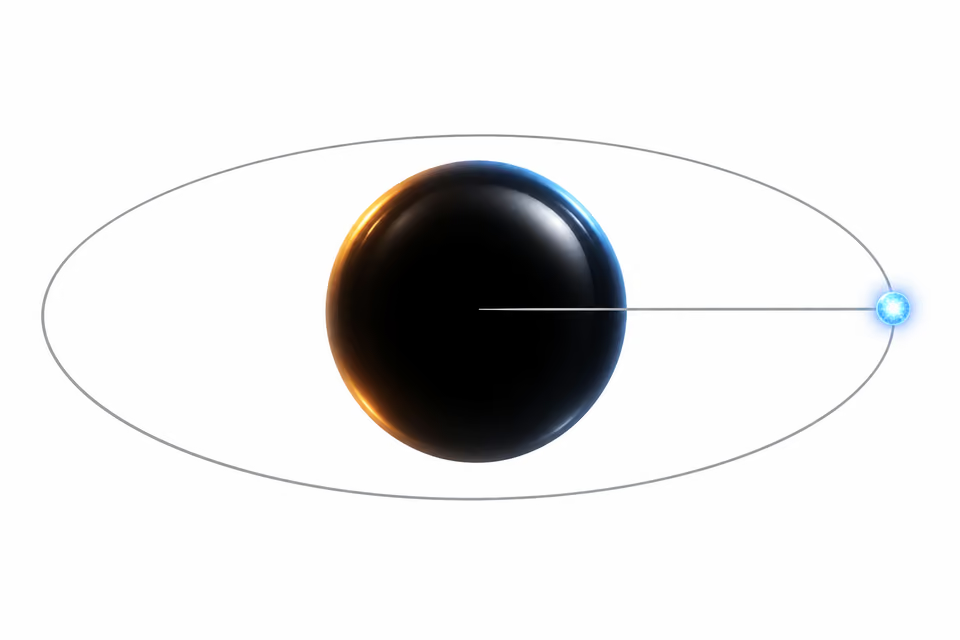
A star of mass \(m\) follows a nearly circular orbit of radius \(r\) around a compact object of mass \(M\). Take \(m\text{≪}M\), so the central object can be treated as fixed. Treat both bodies as point masses. Use Newtonian circular orbits and assume the orbit changes little during one turn. Gravitational radiation is the only mechanism that removes orbital energy. The line in the sketch joins the centres. The circular orbit is seen obliquely, and the bodies are drawn larger for clarity.
The model supplies the following expression for the positive outward power. Here \(K\) is a positive dimensionless constant, \(c\) is the speed of light, \(G\) is the gravitational constant and \(\omega\text{=}2\pi\text{/}T\) is the angular speed.
1. Find the missing exponents and the total orbital energy \(E\). Find the signed rate of change of the orbital period \(T\) in terms of the two masses, \(T\) and constants.
2. Given the initial radius \(r_{0}\) and period \(T_{0}\), predict \(r(t)\) and \(T(t)\). Could the mathematical endpoint of that prediction represent a real merger?
Open hint 1
First hint. Imagine comparing two nearby circular orbits. Which has the larger speed? Which has the larger total energy if you choose zero energy at infinite separation?
Open hint 2
Second hint. Write the energy and the radiated power in terms of the same variable. Choose the sign of each before you differentiate.
Read the worked solution
Start with the proposed power law. The dimensions of power, \(c\) and \(G\) are \(\text{M}\text{L}^{2}\text{T}^{\text{−}3}\), \(\text{L}\text{T}^{\text{−}1}\) and \(\text{M}^{\text{−}1}\text{L}^{3}\text{T}^{\text{−}2}\). Angular speed contributes one inverse power of time. Matching the mass and length exponents gives
Hence \(y\text{=}1\) and \(x\text{=}\text{−}5\). Time supplies a cross-check, since \(\text{−}x\text{−}2y\text{−}6\text{=}\text{−}3\). Dimensions fixed the two missing powers because the powers of \(m\), \(r\) and \(\omega\) were given. They leave the number \(K\) undetermined. There is a deeper ambiguity. The quantity \(c^{5}\text{/}G\) already has the units of power. You could multiply it by any function of the dimensionless ratios \(m\text{/}M\) and \(GM\text{/}\left( c^{2}r \right)\) and still get a power. The physics of radiation selects one such function.
Where the lost energy comes from
In a circular orbit, gravity supplies the centripetal acceleration. With the potential energy set to zero at infinity, this gives
Imagine moving to an orbit with twice the kinetic energy. The potential energy becomes twice as negative. In fact \(E_{\text{p}}\text{=}\text{−}2E_{\text{k}}\), so the total energy is \(E\text{=}\text{−}E_{\text{k}}\text{=}\text{−}GMm\text{/}(2r)\). For every joule the system radiates, the kinetic energy increases by one joule and the potential energy falls by two. The star speeds up as its orbit contracts. The ticks come closer together.
How fast the clock gains
Use \(\omega^{2}\text{=}GM\text{/}r^{3}\) in the radiation formula. With \(P\) positive outwards, the orbital energy obeys \(\text{d}E\text{/}\text{d}t\text{=}\text{−}P\). The coefficient of \(\text{d}r\text{/}\text{d}t\) below is positive, so the radius must decrease.
The power rises as the inverse fifth power of the separation. Two systems with the same masses but slightly different separations can therefore have quite different orbital decay rates.
Reading the next tick
Kepler’s law gives \(T\text{=}2\pi\sqrt{r^{3}\text{/}(GM)}\). A small fractional change in \(r\) produces one and a half times that fractional change in \(T\). Differentiate and then substitute \(r^{3}\text{=}GMT^{2}\text{/}\left( 4\pi^{2} \right)\) to eliminate \(r\).
The negative sign answers the timing question. The exponent tells us more. After the period halves, a one-second interval sees a period change \(2^{5\text{/}3}\) times as large in magnitude. The derivative is measured in seconds per second. There is a quick independent check on the exponent. Kepler’s law gives \(E\text{∝}\text{−}T^{\text{−}2\text{/}3}\) and \(P\text{∝}T^{\text{−}10\text{/}3}\). Then \(\text{d}E\text{/}\text{d}t\text{=}\text{−}P\) requires \(\text{d}T\text{/}\text{d}t\text{∝}\text{−}T^{\text{−}5\text{/}3}\).
The last half of the radius
Multiplying the radius equation by \(r^{3}\) gives \(\text{d}\left( r^{4} \right)\text{/}\text{d}t\text{=}\text{−}4A\). With \(t\text{=}0\) at \(r\text{=}r_{0}\), the two predictions are
How long does the first halving take? Set \(r\text{/}r_{0}\text{=}1\text{/}2\). It takes \(15\tau\text{/}16\), leaving just \(\tau\text{/}16\) for the entire remaining contraction in the formal model. By then \(T\text{/}T_{0}\text{=}1\text{/}\left( 2\sqrt{2} \right)\), and the radiated power has risen by a factor of \(32\).
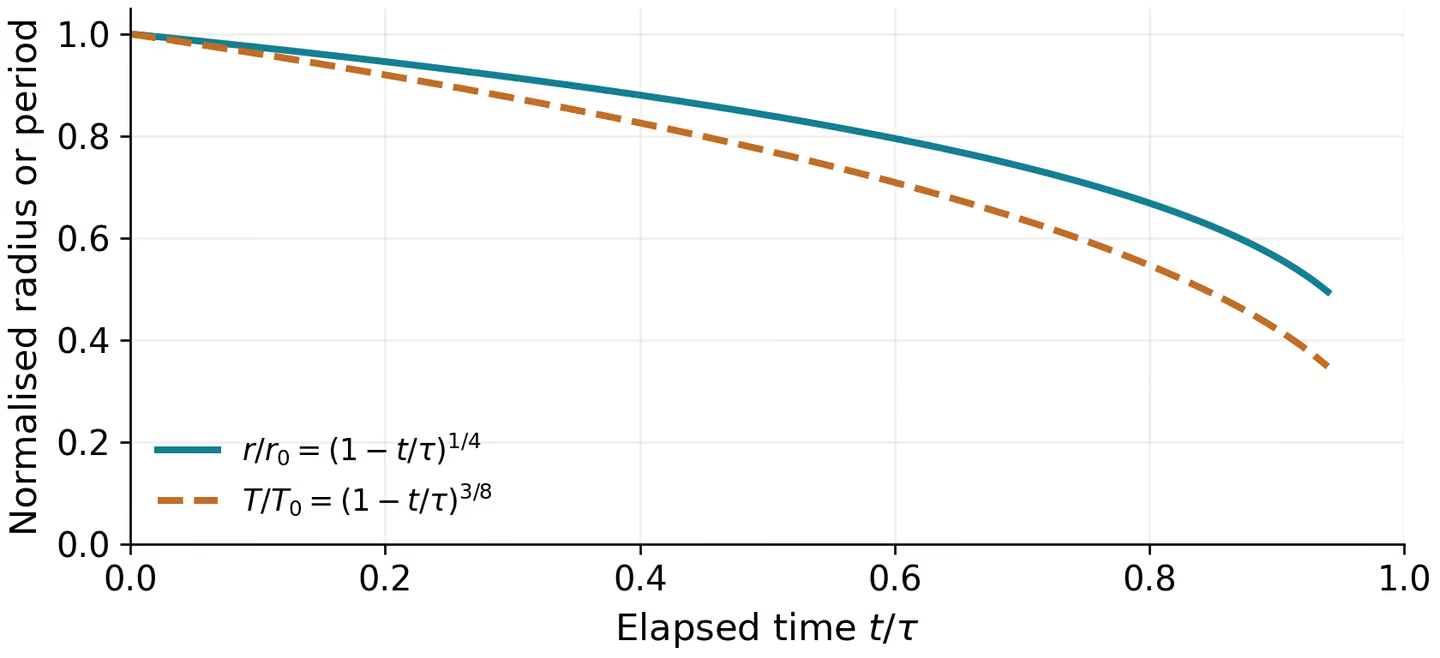
The curves end at the first halving of the radius. Extending them to zero would assume that the same equations hold all the way to merger.
What could a timing record tell us
A sequence of decreasing periods would agree with many models. This one predicts a sharper test. Multiply the period equation by \(T^{5\text{/}3}\) and integrate.
A plot of \(T^{8\text{/}3}\) against elapsed time should be straight. If \(K\) is known, its slope fixes the mass combination \(mM^{2\text{/}3}\). Even perfect timing data obeying this law would leave many pairs of masses possible. A second measurement must distinguish them.
One year of timing
Take \(M\text{=}2.00\text{×}10^{36}\,\text{kg}\), \(m\text{=}2.00\text{×}10^{30}\,\text{kg}\), \(r_{0}\text{=}1.00\text{×}10^{12}\,\text{m}\) and \(K\text{=}6.40\). Use \(G\text{=}6.67\text{×}10^{\text{−}11}\,\text{m}^{3}\,\text{kg}^{\text{−}1}\,\text{s}^{\text{−}2}\) and \(c\text{=}3.00\text{×}10^{8}\,\text{m}\,\text{s}^{\text{−}1}\). One orbit initially takes \(6.30\) days. The radiated power is \(1.67\text{×}10^{27}\,\text{W}\). How much shorter will the orbital period itself be a year later?
Initially \(\text{d}T\text{/}\text{d}t\text{=}\text{−}1.02\text{×}10^{\text{−}11}\,\text{s}\,\text{s}^{\text{−}1}\). Over one year (\(365.25\) days), the period therefore shortens by only \(0.322\,\text{ms}\). This is the change in the duration of one orbit. The first-order estimate works because a year is tiny compared with \(\tau\text{=}6.34\text{×}10^{8}\) years. Even that huge power draws from an orbital binding energy of \(1.33\text{×}10^{44}\,\text{J}\).
Where the prediction ends
The mass ratio \(q\text{=}m\text{/}M\text{=}1.00\text{×}10^{\text{−}6}\) justifies fixing the centre. Two further checks answer different questions. Write \(\chi\text{=}GM\text{/}\left( c^{2}r \right)\). Initially \(v\text{/}c\text{=}\sqrt{\chi}\text{=}0.0385\), and the fractional decrease in radius per orbit is
These numbers support weak gravity and slow evolution at the start. As \(r\) shrinks, \(\chi\) grows. Moreover, a real star has a size and may be disrupted by tides. The model contains neither that size nor strong-field dynamics. Its formal time \(\tau\) cannot give the time of a real merger from these assumptions.
Change one assumption
Double the central mass while keeping \(m\) fixed. At fixed \(r_{0}\), the time \(\tau\) falls by a factor of four. At fixed \(T_{0}\), the straight-line law gives \(\tau\text{=}3T_{0}^{8\text{/}3}\text{/}(8B)\), so the factor is only \(2^{2\text{/}3}\). Which pairs of masses could give exactly the same timing curve, starting at the same period? Give another solver an example to check.
Try a related problem
Three photographs record an expanding shock wave. Can you tell when the pulse occurred?