
Heat Conduction Through a Honeycomb
Before you begin
You should know steady heat conduction, thermal conductivity and conservation of energy. Thermal resistance is introduced below.
Consider a bee giving off heat in the central cell of a small honeycomb. If we surround that cell with one more ring of cells, will its steady temperature rise? The extra ring adds insulating walls, but it also makes the exposed boundary larger.
We will compare the two clusters by balancing heat flow at each type of cell. The key is to identify which cells really are equivalent by symmetry. Equal shapes alone do not guarantee equal temperatures.
State the model and the question
Compare two clusters: one has a central cell and one surrounding ring of six cells; the other has two surrounding rings containing six and twelve cells. The bee is in the central cell in each case.
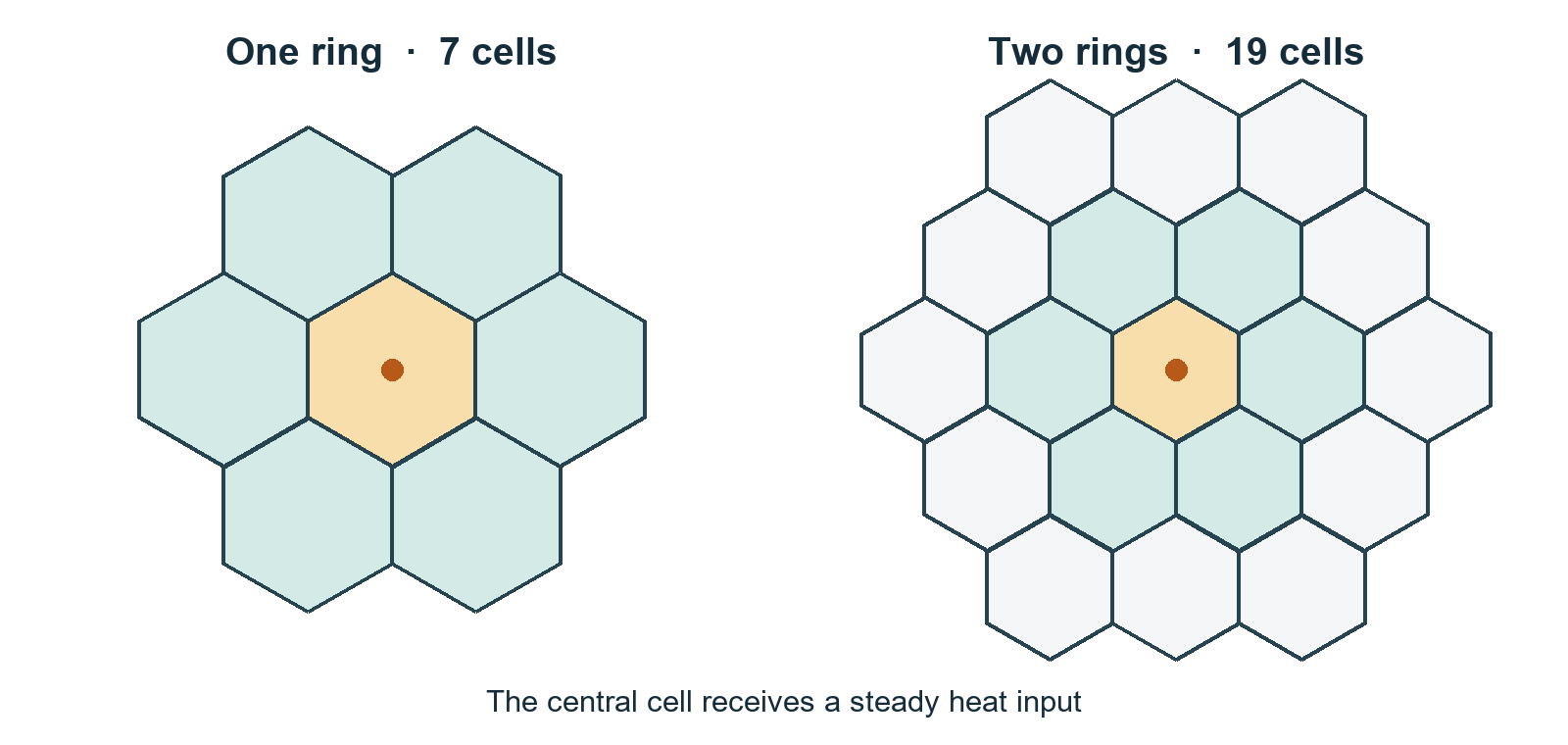
Assume that each cell has a uniform, steady temperature. Heat passes through the vertical walls; the top and bottom are insulated. Every wall has the same dimensions and effective thermal conductivity. The surroundings remain at \(T_0\).
| Quantity | Symbol | Value |
|---|---|---|
| Width of a vertical wall | \(a\) | \(3.0\,\mathrm{mm}\) |
| Height of a vertical wall | \(b\) | \(10\,\mathrm{mm}\) |
| Wall thickness | \(d\) | \(0.20\,\mathrm{mm}\) |
| Effective thermal conductivity | \(K\) | \(0.0030\,\mathrm{W\,m^{-1}\,K^{-1}}\) |
| Heat supplied per second by the bee | \(P_0\) | \(4.0\,\mathrm{mW}\) |
| Surrounding temperature | \(T_0\) | \(5.0\,{}^\circ\mathrm{C}\) |
Find the central-cell temperature for each cluster. The supplied \(K\) already includes the insulating effect of air; do not add a separate air resistance. This is an ideal heat-conduction model, not a model of every heat-transfer process in a living hive.
Replace one wall by a thermal resistance
Heat crosses the wall thickness \(d\). The area perpendicular to the heat flow is \(ab\), not the area of the cell floor. If the temperatures on the two sides are \(T_{\mathrm{h}}>T_{\mathrm{l}}\), the heat-transfer rate is
Here \(H\) is heat transferred per second and \(R_{\mathrm{th}}=d/(Kab)\) is the thermal resistance of one wall. Thus
A larger resistance requires a larger temperature difference to carry the same heat rate. Temperature differences have the same numerical value in kelvin and degrees Celsius. The extra digits in the calculations below are retained only for checking.
One surrounding ring
Let the central-cell temperature be \(T_{\mathrm{c},1}\). Successive rotations through \(60^\circ\) exchange the surrounding cells without changing the source or the boundary. All six surrounding cells therefore have the same temperature, \(T_{\mathrm{s}}\).
Each surrounding cell touches the centre through one wall, two other surrounding cells through two walls, and the outside through three walls. The walls joining equal-temperature cells carry no net heat.
Follow the two temperature drops
The central source sends \(P_0\) through six identical walls. Each carries \(P_0/6\), so
The six surrounding cells expose \(18\) walls to the outside. Each has the same temperature drop, giving
Add the two drops:
Check The surrounding cells are at \(5.4938\,{}^\circ\mathrm{C}\), above the surroundings and below the centre. The equivalent resistance is \(R_{\mathrm{th}}/6+R_{\mathrm{th}}/18=2R_{\mathrm{th}}/9\).
Pause and explain Why is a boundary cell not at \(T_0\)? Its walls have finite resistance. A temperature difference is needed to pass heat to the surroundings.
Two rings contain four temperature groups
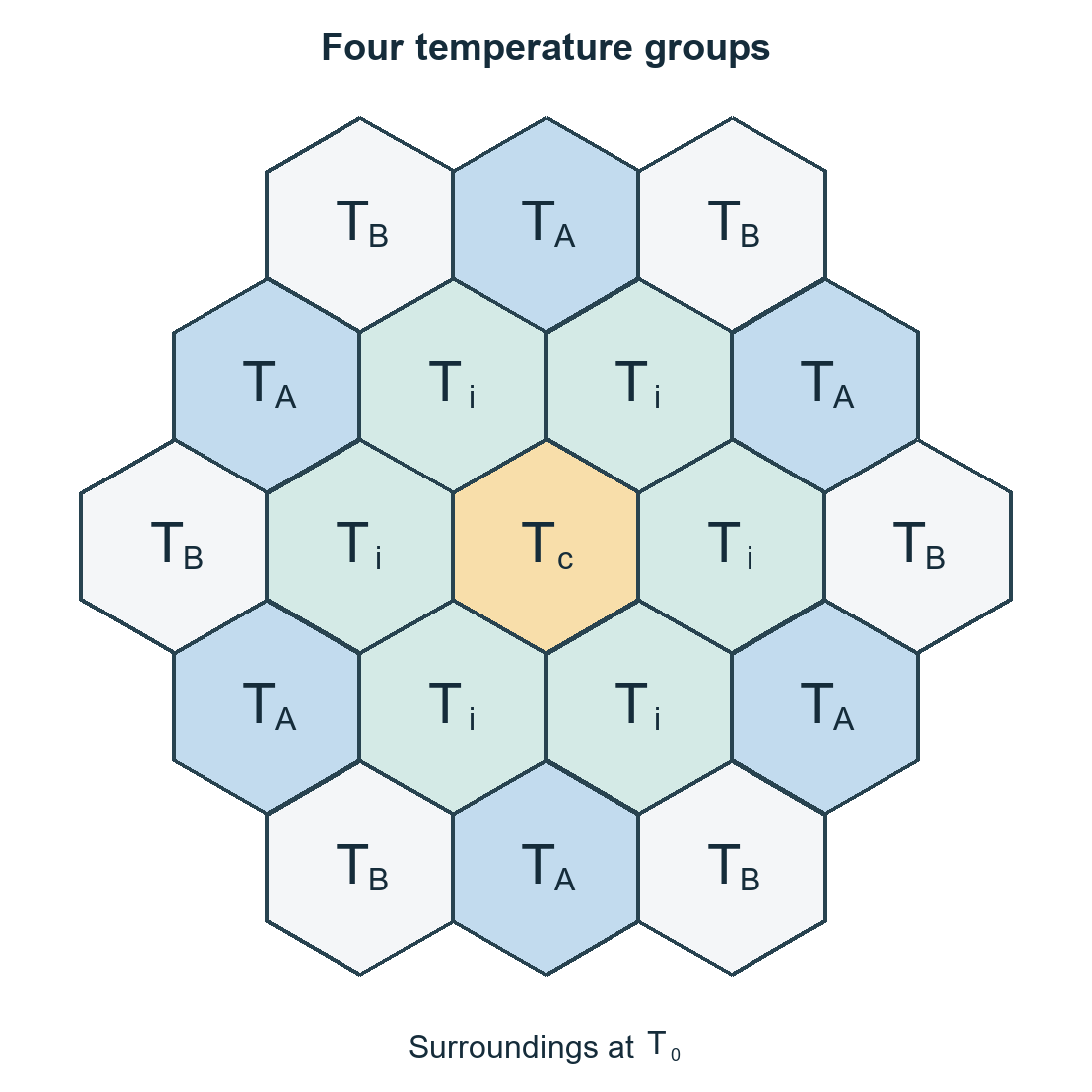
The central cell has temperature \(T_{\mathrm{c}}\), and the six first-ring cells share temperature \(T_{\mathrm{i}}\). The twelve outer cells divide into two sets of six. An A cell touches two first-ring cells; a B cell touches only one. They cannot all be assigned one temperature by symmetry.
Count every wall before writing a balance
| Representative cell | Neighbouring cells | Walls facing outside |
|---|---|---|
| Inner cell | 1 central, 2 inner, 2 A and 1 B | 0 |
| A cell | 2 inner and 2 B | 2 |
| B cell | 1 inner and 2 A | 3 |
Each row accounts for six walls. Inner-to-inner walls carry no net heat. Keep the A-to-B walls: their two temperatures are not known to be equal.
Steady temperature does not mean that heat flow has stopped. For every empty cell, heat received per second equals heat lost per second.
Write one heat balance for each type of cell
The centre again loses heat through six identical walls. Define the known temperature drop
For an inner cell, heat from the centre leaves through two walls towards A cells and one wall towards a B cell. Multiplying by the common wall resistance gives
For an A cell, two inner neighbours supply heat. The cell passes heat through two walls towards B cells and two walls to the outside:
For a B cell, heat arrives from one inner cell and two A cells, then leaves through three exterior walls:
These are signed balances. If an assumed direction were wrong, the corresponding temperature difference would be negative. The solution will tell us the directions.
Solve for temperature rises above the outside
Put \(x=T_{\mathrm{i}}-T_0\), \(y=T_{\mathrm{A}}-T_0\) and \(z=T_{\mathrm{B}}-T_0\). Equations (7) to (9) become
The last two equations give \(x=3y-z\) and \(x=6z-2y\). Hence \(5y=7z\), followed by \(y=7x/16\) and \(z=5x/16\). Substitution in the first equation gives
The central cell is another \(\Delta\) warmer than the inner ring. Therefore
The temperatures below retain extra digits to make the balances easy to check.
| Region | Rise above the surroundings | Temperature |
|---|---|---|
| Central cell | \(45\Delta/29\) | \(7.2989\,{}^\circ\mathrm{C}\) |
| Inner cells | \(16\Delta/29\) | \(5.8174\,{}^\circ\mathrm{C}\) |
| Outer A cells | \(7\Delta/29\) | \(5.3576\,{}^\circ\mathrm{C}\) |
| Outer B cells | \(5\Delta/29\) | \(5.2554\,{}^\circ\mathrm{C}\) |
| Surroundings | \(0\) | \(5.0000\,{}^\circ\mathrm{C}\) |
Check the heat leaving the whole cluster
There are twelve exterior walls belonging to A cells and eighteen belonging to B cells. The total heat-transfer rate to the outside is
All of the generated heat leaves the cluster, as it must in steady state. The ordering \(T_{\mathrm{c}}>T_{\mathrm{i}}>T_{\mathrm{A}}>T_{\mathrm{B}}>T_0\) also confirms that heat passes from A cells to B cells.
The equivalent resistance rises from \(2R_{\mathrm{th}}/9\) to \(15R_{\mathrm{th}}/58\). The second ring raises the central temperature by about \(0.324\,\mathrm{K}\), increasing the rise above the surroundings by about \(16.4\%\). In this model it improves insulation despite the larger exposed boundary.
Test the reasoning
1 Equal shapes Why did the first ring have one temperature, while the second ring needed two?
2 A missing heat path What would be wrong with deleting heat transfer between A and B cells before solving?
3 A steady state Why did no heat capacity enter the calculation?
Answers and reasoning
1 The symmetry must preserve both the heat source and every thermal connection. It exchanges all six first-ring cells, but it does not exchange an outer cell with two inner neighbours and one with only one.
2 That deletion assumes equal temperatures before they have been established. The solution gives \(T_{\mathrm{A}}>T_{\mathrm{B}}\), so those shared walls carry heat.
3 Every cell has constant temperature, so its internal energy is no longer increasing. The calculation balances rates of heat flow. Heat capacity would be needed to study the approach to this state.
Sources and further reading
The physical problem and numerical data are from DMFA Slovenije, 62nd Slovenian High School Physics Competition, national round, 13 April 2024, Group II, Problem 4. Original question and official solutions (question on PDF page 5; solution on PDF pages 17–18). This article presents an independently written explanation and newly drawn diagrams of the model.