
When a thread loop locks on a cylinder
Tie two loops in identical pieces of thread. One is 14.0 cm long, the other 15.0 cm. Pull each down the same cylinder by its free end. One loop grips the cylinder while the other can slide. Which one would you choose if you wanted the knot to move?
The challenge
A fixed cylinder of radius \(R\) passes through a loop of length \(L > 2\pi R\). The knot \(P\) joins the two sides of the loop to a free tail. Pull the tail parallel to the cylinder axis. The thread is flexible and inextensible, and it does not twist. Neglect its weight and thickness. Assume a long cylinder and a uniform coefficient of static friction \(\mu > 0\).
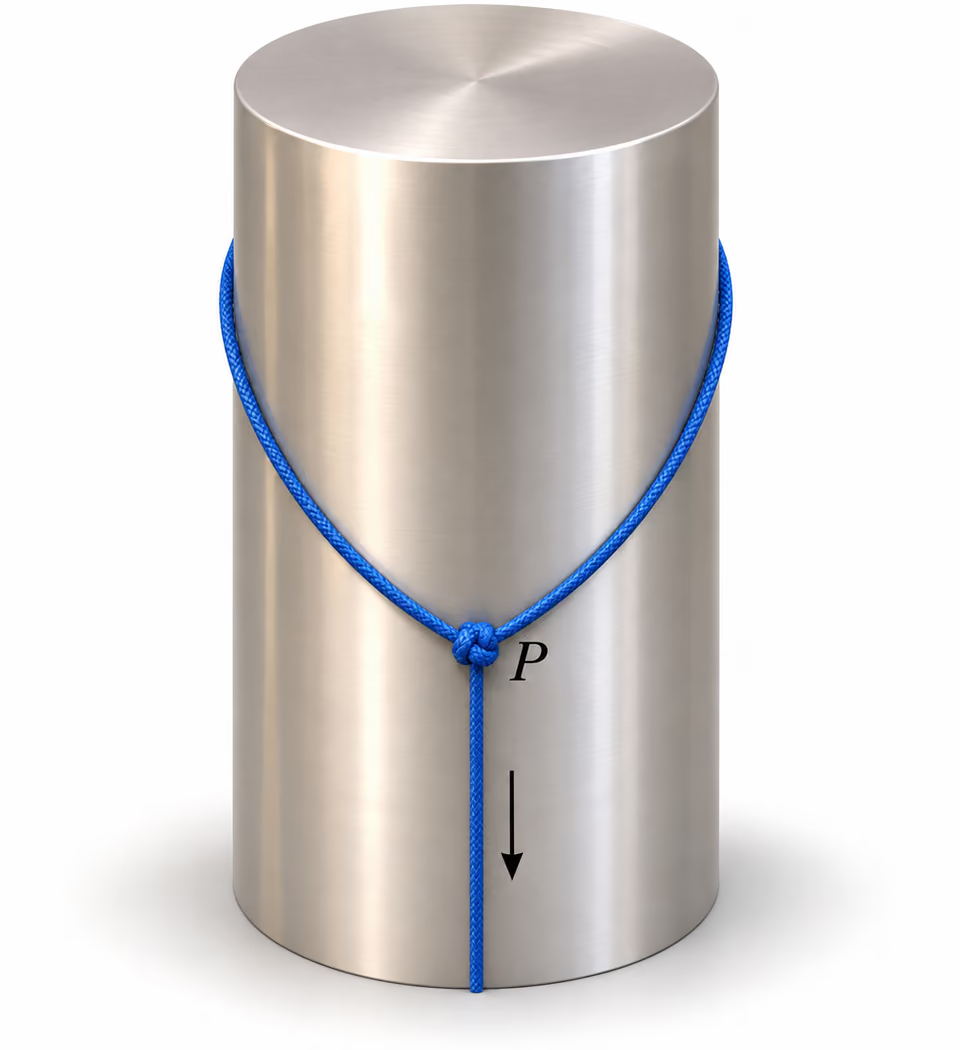
Find the critical length \(L_{0}\) at which the taut loop is just able to slide along the cylinder without changing shape. Which lengths can lock? Could you free a locked loop simply by increasing the pull? For the two loops above, take \(R = 2.00\, cm\) and \(\mu = 0.30\).
Before you calculate, sketch the direction in which a small ink mark on the thread would travel at the instant the loop began to slide.
Open hint 1
1. Follow the mark. Suppose the loop translates bodily. Where on the cylinder would the ink mark go? Draw the friction force that would oppose that motion.
Open hint 2
2. Cut along the knot. Imagine peeling the cylinder’s surface off as a sheet. Which component of the tension is carried unchanged along a short piece of thread? What does the flat sheet hide about that component?
Read the worked solution
The force the flat drawing hides
The ink mark would move straight down, even where the thread itself runs obliquely. At impending slip the cylinder therefore exerts upward friction on every element. A familiar rope-on-a-drum argument assumes the rope slips along its own length. Here that assumption would give the wrong direction for friction.
Cut the surface along the line through \(P\) parallel to the axis. On the sheet let \(x\) measure distance around the circumference and \(z\) distance down the axis. Choose the highest point \(O\) as the origin. By symmetry it is halfway round the cylinder from \(P\). The right half of the unfolded loop extends from \(x = 0\) to \(x = \pi R\).
Consider a small piece on this half. The normal force is radial, and friction is axial. Neither acts around the circumference. Hence the circumferential component \(H\) of tension has constant magnitude. The axial component \(T_{z}\) changes with the slope, since the tension points along the thread.
Now look down on the cylinder. As the thread advances a distance \(dx\) around the circumference, \(H\) turns through \(d\phi = dx/R\). The two end forces on the small piece have an inward resultant of magnitude \(H\, d\phi\). The cylinder supplies an equal outward normal force.
This is the part of the calculation that needs the cylinder. Unrolling preserves distances and slopes, but the flat sheet cannot show how a circumferential tension changes direction in space.
From a local balance to a loop length
For the small piece, the increase in downward tension balances the upward friction. At impending slip, \(dT_{z} = \mu\, dN\). Substitute the two expressions from the previous step.
The pull has dropped out. Because \(z(0) = z\prime(0) = 0\), the slope is \(z\prime = \mu x/R\) and the unfolded thread follows a parabola, \(z = \mu x^{2}/(2R)\). In the drawing, both points labelled \(P\) are the same knot. Rolling up the sheet brings them together.
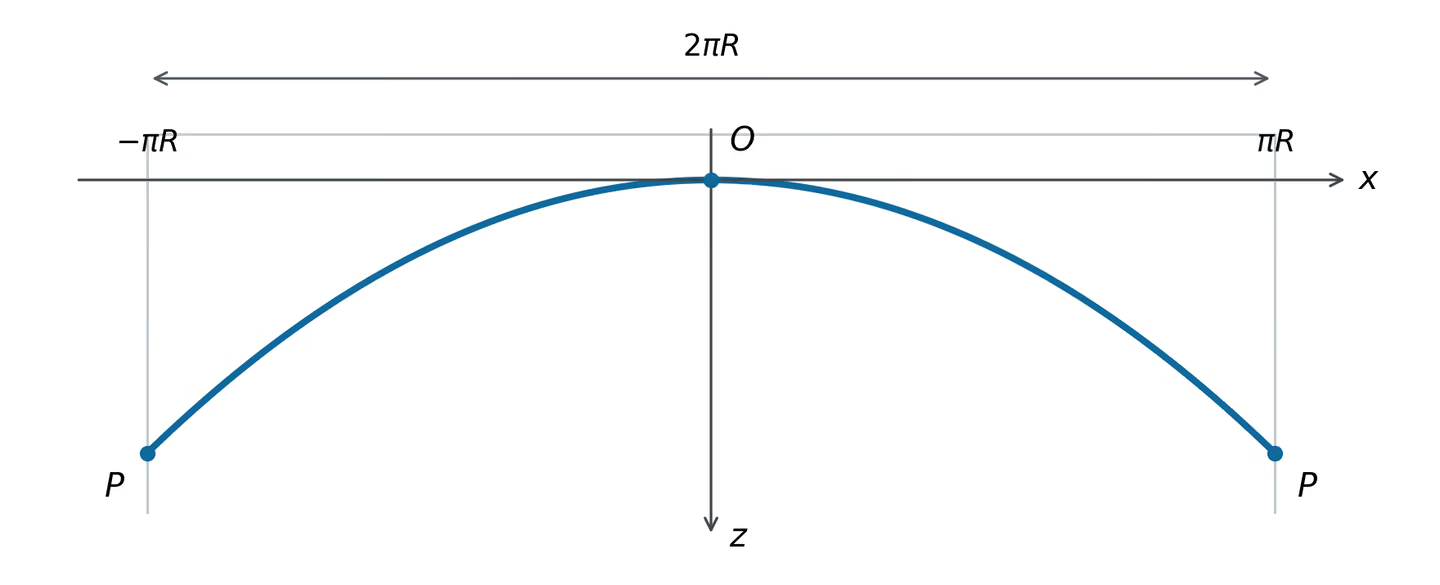
The horizontal width is one circumference. The thread follows the longer, curved path. Using \(ds = \sqrt{1 + (dz/dx)^{2}}\, dx\) gives
Set \(u = \mu x/R\). Use the antiderivative \(\frac{1}{2}\left\lbrack u\sqrt{1 + u^{2}} + \ln\left( u + \sqrt{1 + u^{2}} \right) \right\rbrack\) between zero and \(\pi\mu\). The critical length is
Every piece would slip axially at the threshold, so all of it must fit this limiting profile. A shorter loop cannot trace that profile around a full circumference.
For the cylinder in the challenge, \(L_{0}\) is about 14.2 cm. The 14.0 cm loop can lock. The 15.0 cm loop can slide. More generally the locking interval is \(2\pi R < L < L_{0}\), with \(L = L_{0}\) the marginal case. Lengths above \(L_{0}\) lie in the sliding regime.
Why doubling the pull changes nothing
How can the shorter loop hold before friction reaches its limit? Try the same parabola with a smaller slope parameter \(\nu\), so \(z\prime = \nu x/R\) and \(0 < \nu < \mu\). It needs only \(df = \nu\, dN\) on each piece. Its arc length increases continuously from \(2\pi R\) to \(L_{0}\) as \(\nu\) increases from zero to \(\mu\). This constructs a static shape for every length in the locking interval.
At the knot, each side pulls upwards with axial component \(\pi\nu H\). The free tail pulls down with force \(F\), so \(F = 2\pi\nu H\). Double \(F\) and the same shape doubles \(H\), the normal force on each piece and the friction required. The ratio \(df/dN\) stays at \(\nu\). There is no critical pulling force in this ideal model.
For the 14.0 cm loop, substituting \(\nu\) for \(\mu\) in the arc-length integral and solving for \(\nu\) gives 0.276. In this static shape the loop uses about 92% of the available friction, however large the applied pull is, so long as the thread stays intact.
Where the thread would break
The shape determines the load in the strands. The tension is greatest next to \(P\), where the slope is steepest. Taking the magnitude of the tension vector there gives
The free tail itself carries \(F\). At the marginal length with \(\mu = \nu = 0.30\) and \(F = 10.0\, N\), the greatest loop tension is 7.29 N. Here the tail would break first if the whole thread had the same breaking tension and the knot did not weaken it. For a sufficiently short loop the ranking reverses. Setting \(T_{max} = F\) gives the crossover \(\nu = 1/\left( \pi\sqrt{3} \right)\).
One last prediction. Suppose you double the friction coefficient on a nearly smooth cylinder. What happens to the extra length a loop can have and still lock? Expand the integrand for small \(\mu\). The leading excess is \(L_{0} - 2\pi R \simeq \pi^{3}R\mu^{2}/3\). That extra length grows by a factor of about four. A small axial slope adds to the arc length only at second order.
For discussion. You have a ruler but no force gauge. Could the height difference between \(O\) and \(P\) give you the coefficient of friction? Say when you would have to take the measurement, and what an earlier measurement would tell you.
Try a related problem
If the two surfaces of stacked blocks reach the same velocity, what decides whether they stay together?