
When two blocks match velocities
Freeze the motion the first time the blocks have the same velocity after slipping. Draw an acceleration arrow for each block for the next instant. Must your two arrows agree?
The challenge
A light horizontal spring of force constant \(k\) joins a fixed support to the upper block of mass \(m\). The long lower block of mass \(M\) rests on a smooth horizontal floor. The coefficient of friction between the blocks is \(\mu > 0\), with the same value for static and kinetic friction. The spring obeys Hooke’s law in extension and compression.
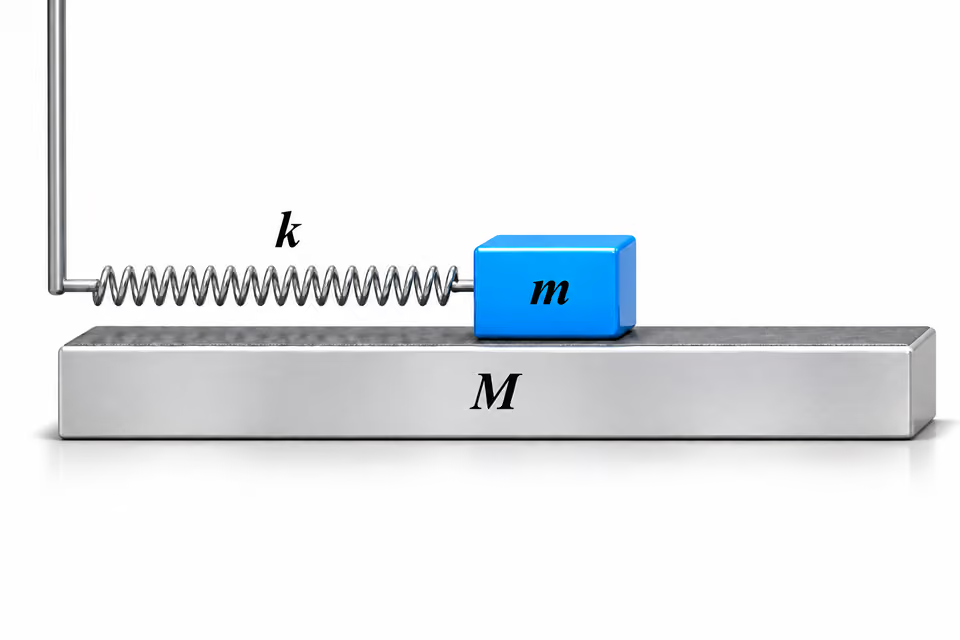
Hold the lower block in place and pull the upper block a distance \(A\) to the right from the position where the spring has its natural length. Release both from rest. The support clears the lower block, and the upper block never reaches its edge.
1. How far can you pull before slipping becomes inevitable? Find the greatest amplitude \(A_{c}\) for which the blocks can move together throughout.
2. For \(A > A_{c}\), follow the first slip up to the instant the velocities match. How can you decide whether the blocks then stick or immediately slide the other way relative to each other?
3. For \(A \gg A_{c}\), estimate the upper block’s loss of amplitude per oscillation and the lower block’s greatest speed during the first oscillation.
Open hint 1
First hint. Imagine tying the two blocks together. What force would the lower block need from its neighbour, and where in the oscillation would it need the most?
Open hint 2
Second hint. During a slip, sketch both velocities on the same axes. At their first intersection, ask what force would keep their slopes equal.
Read the worked solution
The threshold for slipping
Take right as positive. Write \(x\) for the upper block’s displacement from the position of zero spring extension, and \(X\) for the lower block’s displacement from its release position. If the blocks move together, the spring accelerates their combined mass. The only horizontal force on the lower block is friction, so the friction it needs is
The upper block presses on the lower one with a normal force \(mg\). Write \(f_{0} = \mu mg\) for the greatest available friction. The demand peaks at the turning points, where \(|x| = A\). Equating that demand to \(f_{0}\) gives
At or below this amplitude, static friction can sustain the common oscillation of angular frequency \(\Omega = \sqrt{k/(m + M)}\). From the right turning point to the centre, friction supplies energy to the lower block at exactly the rate it takes energy from the upper block. Their common contact velocity makes the net frictional power zero.
The first slip
Above the threshold, the upper block starts sliding left across the lower one. Friction now acts right on \(m\) and left on \(M\). Put \(b = f_{0}/k\), \(a_{0} = f_{0}/M\) and \(\omega = \sqrt{k/m}\). The spring and kinetic friction together exert the force \(- k(x - b)\) on the upper block. It oscillates about \(b\) as long as this direction of slip persists. The lower block accelerates uniformly. With \(\theta = \omega t\) their motions are
Both velocity curves start at zero. The spring makes the upper block’s velocity more negative at first, but its acceleration will change continuously. The lower block’s velocity keeps falling along a straight line while the two surfaces slide in the same relative direction. A reversal of the upper block’s acceleration alone would not end the slip.
Following these equations beyond the first return to \(w = 0\) would keep applying the old friction force after its physical justification had expired.
What happens where the velocities meet
The first slip ends when \(w\) returns to zero. In the first-slip velocity equations, a sine curve meets a straight line. Their intersection at the first positive angle \(\theta_{e}\) satisfies
Since \(A > A_{c}\), we have \(0 < \rho < 1\). On \(0 < \theta < \pi\), the ratio \(\sin\theta/\theta\) falls from 1 to 0. There is exactly one crossing there, before the upper block reaches its left turning point.
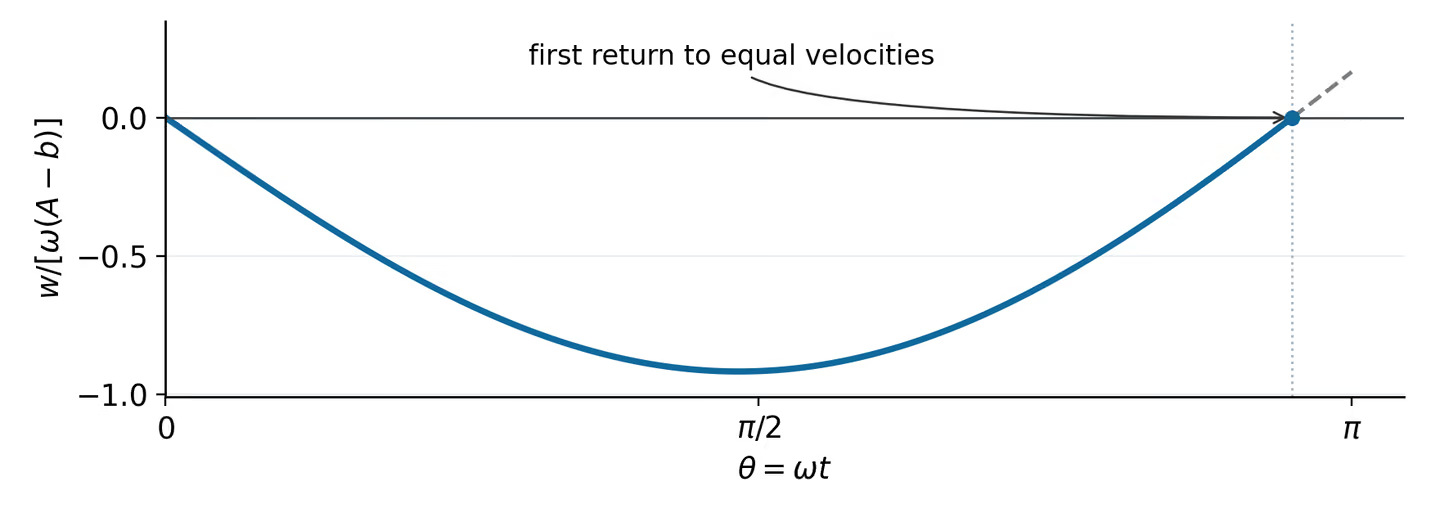
The plot uses equal masses and \(A = 10A_{c}\). The grey dashed line continues the old equation beyond its range of validity. What the blocks actually do there depends on the force they need.
At the crossing, \(t_{e} = \theta_{e}/\omega\). Both blocks move left with velocity \(v_{e} = - a_{0}t_{e}\), and \(x_{e} = b + (A - b)\cos\theta_{e}\). Test the friction for common acceleration again. It is available when \(|x_{e}| \leq A_{c}\). The sign of the common velocity settles what happens at the boundary.
Inside the interval \(|x_{e}| < A_{c}\), the blocks stick for at least a while. The resulting common oscillation would have amplitude
If \(B > A_{c}\), common motion lasts only until the blocks reach the boundary on their way out. A pair at the right boundary moving left would enter the allowed interval. At \(x_{e} = - A_{c}\) the blocks are already moving outwards to the left. No interval of sticking can begin. For \(x_{e} < - A_{c}\) the spring pushes the upper block right too strongly for friction to hold the pair together. In both cases the upper block starts sliding right relative to the lower one, even while both still travel left.
A second threshold to find
Try equal masses. Is there a particular initial pull at which the first catch changes from temporary sticking to immediate reversal? Eliminate \(A - b\) using the crossing equation. Since \(A_{c} = 2b\), the test takes the form
As the pull grows, \(\theta_{e}\) increases towards \(\pi\) and this expression decreases. The boundary \(x_{e} = - A_{c}\) gives \(\theta_{e}\cot\theta_{e} = - 3\). Its root is about \(2.456\) radians, corresponding to \(A \simeq 2.438A_{c}\). Just below that second threshold the blocks stick for a finite time. At the threshold itself they immediately reverse their relative sliding.
What a large pull changes
For \(A \gg A_{c}\), the first catch occurs close to a half period of the upper block. Setting \(\theta_{e} = \pi - \varepsilon\) in the crossing equation gives \(\varepsilon \simeq \pi\rho\). The lower block’s speed peaks locally at the reversal. Its exact value there is \(a_{0}\theta_{e}/\omega\). Over the first oscillation its velocity is approximately triangular, with acceleration \(- a_{0}\) and then \(+ a_{0}\) over successive half periods. Thus the greatest speed to leading order is
What sets the energy loss? The frictional forces have opposite signs, so their powers sum to \(- f_{0}|\dot{x} - \dot{X}|\) during sliding. Heat therefore records the distance one surface travels relative to the other. Over a large oscillation the lower block travels little compared with \(A\). The relative sliding distance is approximately \(4A\). Let \(\Delta A\) be the decrease between successive right turning points. To leading order,
Doubling a sufficiently large initial pull doubles the heat released in the first cycle. It also doubles the energy cost per unit decrease of amplitude. Those two factors cancel. The same estimate loses accuracy as the motion approaches the sticking threshold.
One numerical check
Take \(m = M = 1.00\, kg\), \(k = 20.0\, N\, m^{- 1}\), \(\mu = 0.200\), \(g = 9.81\, m\, s^{- 2}\) and \(A = 10A_{c}\). The exact first catch gives \(t_{e} = 0.6672\, s\) and lower block speed \(1.309\, m\, s^{- 1}\), against the half-period estimate of \(1.378\, m\, s^{- 1}\).
At this catch, \(x_{e} = - 1.743\, m\) and \(X_{e} = - 0.4367\, m\). The upper block has slid left across the lower one by \(A - x_{e} + X_{e}\). Multiplying by \(f_{0}\) gives \(6.412\, J\) of heat, using unrounded values. Independently the system’s mechanical energy falls from \(38.494\, J\) to \(32.083\, J\), the same loss within rounding.
How different are the arrows? Immediately after this catch the lower block accelerates right at \(f_{0}/M = 1.96\, m\, s^{- 2}\). The upper block also accelerates right, at \(\left( - kx_{e} - f_{0} \right)/m = 32.9\, m\, s^{- 2}\). Both blocks are still travelling left.
Now change just the initial pull to \(1.10A_{c}\). The same crossing equation gives \(x_{e} = 0.811A_{c}\) and \(B = 1.088A_{c}\). This time the arrows coincide for a while. As the pair moves left through the centre and reaches \(- A_{c}\), the common acceleration again demands more friction than is available just beyond that point. The sketch that answered the first catch cannot settle the rest of the oscillation.
Try a related problem
A loop of thread grips a cylinder. Which way would friction act if you pulled the knot down its side?