
Ice Pellets
Before you begin
You should know latent heat, specific heat capacity and areas of triangles and trapeziums. The final temperature calculation uses a first-order differential equation and an exponential solution.
A falling ice pellet can melt in a warm layer and freeze again in colder air below. We can find how much refreezes without knowing its mass or fall speed. The key is to compare areas on the air-temperature graph. After melting is complete, the same heat-transfer law tells us why liquid water remains slightly cooler than the surrounding air.
The problem
A small spherical ice pellet falls at a constant terminal speed \(v\). Its mass \(m\) and size stay constant. Its temperature is uniform throughout, but may differ from the air temperature. Let \(h\) be height above the ground, \(\theta_a\) the air temperature and \(\theta_d\) the droplet temperature.

Join successive tabulated points by straight lines in each profile.
| Height \(h\) in km | 4 | 2 | 1 | 0 |
|---|---|---|---|---|
| With inversion \(\theta_a\) in \(^{\circ}\mathrm{C}\) | 0 | 4 | \(-4\) | \(-2\) |
| Without inversion \(\theta_a\) in \(^{\circ}\mathrm{C}\) | 0 | 4 | 6 | 8 |
At \(h_A=4\,\mathrm{km}\) the pellet is pure ice at \(0^{\circ}\mathrm{C}\). In the profile with inversion, it just finishes melting at the lower zero-temperature crossing \(h_B\). Ice and water coexist at \(0^{\circ}\mathrm{C}\), and freezing begins without supercooling or delay.
Heat enters the droplet at the rate
The coefficient \(H\), in \(\mathrm{W\,K^{-1}}\), is constant and has the same value in both profiles. Assume constant air density. Neglect evaporation, condensation, size changes and aerodynamic or viscous heating.
Use \(c_w=4.2\,\mathrm{kJ\,kg^{-1}\,K^{-1}}\) for water, \(c_i=2.1\,\mathrm{kJ\,kg^{-1}\,K^{-1}}\) for ice and \(L=334\,\mathrm{kJ\,kg^{-1}}\) for the latent heat of fusion.
Part a With inversion, what fraction of the original mass refreezes before reaching the ground?
Part b For the same droplet, speed and coefficient, find the ground-level droplet temperature without inversion. Account for its finite thermal response.
Turn graph areas into heat
The lower zero crossing is halfway between 1 km and 2 km, so \(h_B=1.5\,\mathrm{km}\). During melting or freezing the droplet stays at \(0^{\circ}\mathrm{C}\). Heat changes its phase rather than its temperature.
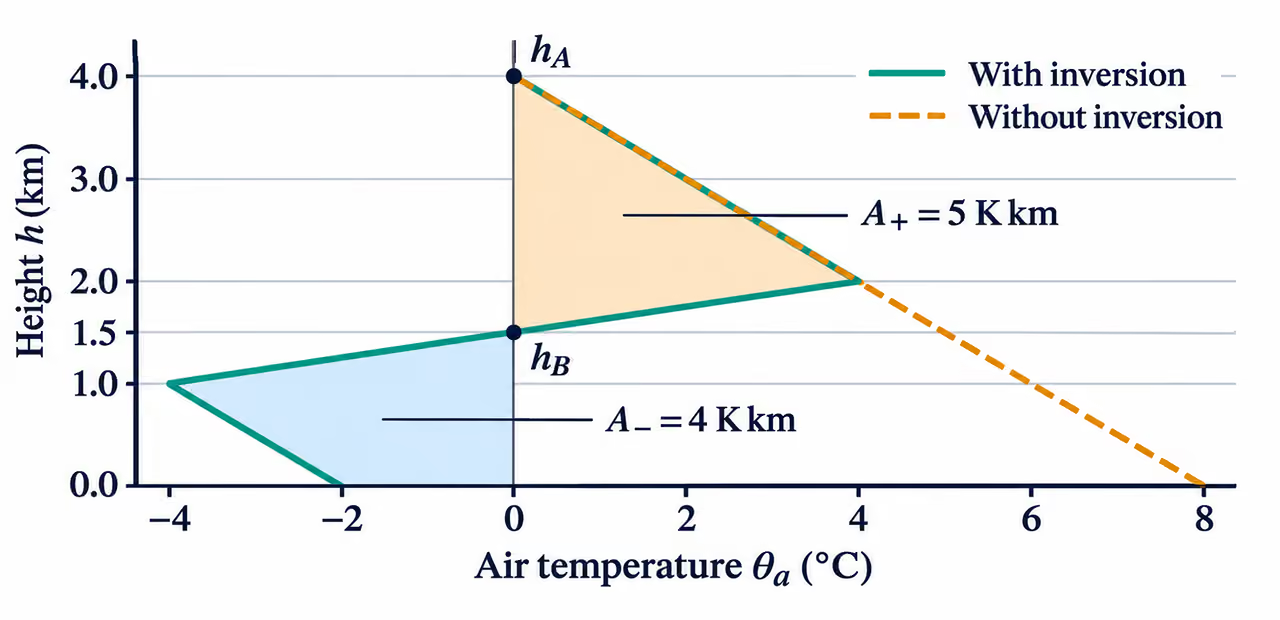
The warm region is a triangle. Its area is
The cold region consists of a triangle and a trapezium:
As the droplet descends, \(dh/dt=-v\). The time spent in a height interval is its vertical distance divided by \(v\). Integrating equation (1) while the droplet is at its melting point gives the positive heat magnitudes
Use \(A_+=5000\,\mathrm{K\,m}\) and \(A_-=4000\,\mathrm{K\,m}\) when \(v\) is in metres per second. The stated melting condition fixes the unknown combination of parameters:
If a fraction \(\eta\) refreezes, it releases \(\eta mL\). Dividing the two heat balances eliminates the unknown mass, speed and coefficient:
Eighty per cent refreezes and twenty per cent remains liquid. Since freezing is incomplete, the droplet reaches the ground at \(0^{\circ}\mathrm{C}\) even though the air there is at \(-2^{\circ}\mathrm{C}\).
Find where melting ends without inversion
Without inversion the air warms at \(b=2.0\,\mathrm{K\,km^{-1}}\) as the droplet falls. The heat needed to melt the same pellet is unchanged. The accumulated area must again reach \(A_+\).
Let \(z_m\) be the distance descended from \(h_A\) when melting finishes. Then
The corresponding height is
The droplet is still at \(0^{\circ}\mathrm{C}\) at that instant. The air temperature is
Subsequent heat input warms liquid water.
Follow the temperature lag
Let \(x\) be the distance descended after melting finishes. Use metres from here, so \(b=0.0020\,\mathrm{K\,m^{-1}}\). The air temperature is
The heat-capacity equation is
Define the thermal response length
Using the melting balance in equation (5) gives
The temperature lag \(\delta=\theta_a-\theta_d\) therefore obeys
Subtract the constant particular solution \(b\ell\). If \(y=\delta-b\ell\), then \(dy/dx=-y/\ell\), so \(y=y(0)e^{-x/\ell}\). At melting completion, \(\delta(0)=4.472136\,\mathrm{K}\). Hence
At the ground, \(x=h_m=1763.932\,\mathrm{m}\) and \(x/\ell\simeq28.05\). The exponential contribution is only \(2.84\times10^{-12}\,\mathrm{K}\). Thus
The ground-level air temperature is \(8.0^{\circ}\mathrm{C}\), so
At the precision of the given data, the answer is approximately \(7.9^{\circ}\mathrm{C}\). Extra digits describe the ideal model, not measurement precision.
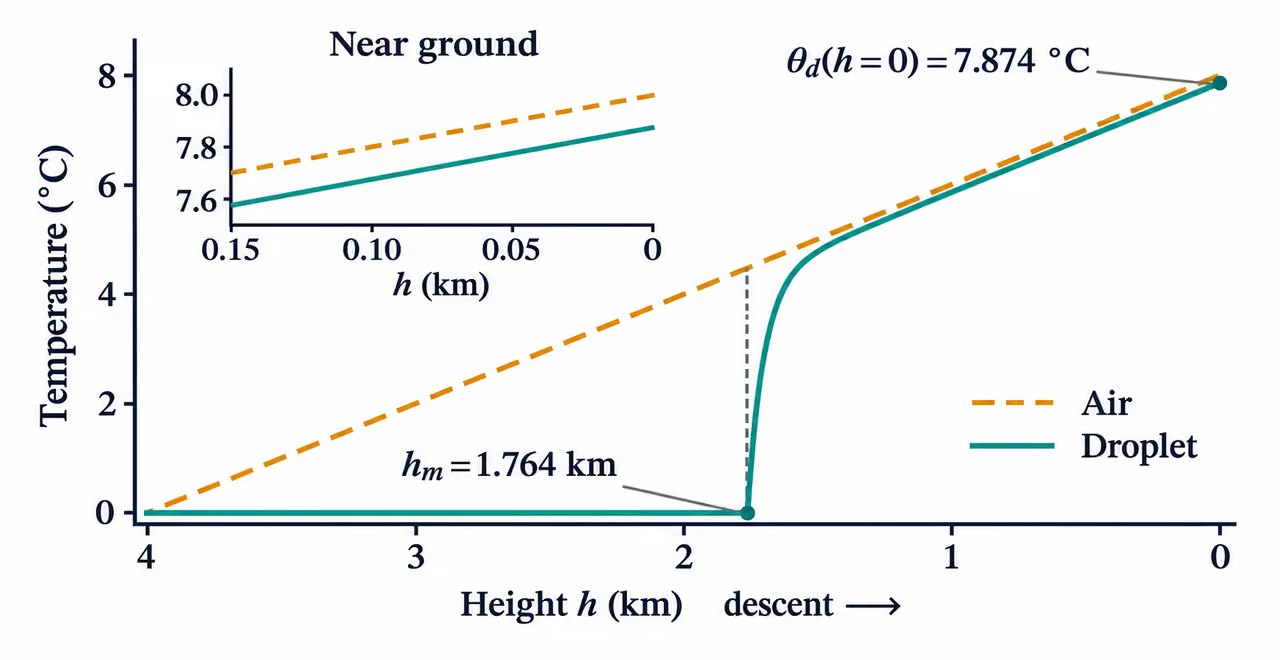
After the initial transient, air and water warm at almost the same rate. The persistent lag \(b\ell\) provides the heat needed to warm the water. If \(\tau=mc_w/H\) is the response time, then \(\ell=v\tau\).
Read the result physically
| Quantity | Result |
|---|---|
| Refrozen fraction with inversion | \(0.80\) of the original mass |
| Ground temperature with inversion | \(0^{\circ}\mathrm{C}\) with ice and water present |
| Melting height without inversion | \(1.764\,\mathrm{km}\) |
| Thermal response length | \(62.87\,\mathrm{m}\) |
| Ground temperature without inversion | \(7.87^{\circ}\mathrm{C}\) or about \(7.9^{\circ}\mathrm{C}\) |
Internal uniformity does not imply equality with the air. High conductivity removes temperature differences inside the droplet. Heat exchange across its boundary still takes time, so its uniform temperature may differ from the air temperature.
Use latent heat only during phase change. Once all ice has melted, use \(mc_w\,d\theta_d\) for the heat input. The supplied ice heat capacity \(c_i\) is unused because the initial ice is already at its melting point.