
Infinite Copper Lattice
Before you begin
You should know Fourier’s law for a wire and conservation of energy at a junction. We will use the fact that the heat currents produced by two thermal sources can be added when the conductivity is constant.
Two neighbouring junctions of a copper lattice are kept at different temperatures. Fourier’s law gives the heat current in the wire joining them. How much heat leaves the hot junction through the whole lattice? Symmetry lets us find it without calculating every junction temperature.
The problem
The junctions of an infinite face-centred cubic lattice lie at the corners and face centres of an array of identical cubes. One copper wire connects each pair of nearest neighbours. Every wire has the same length, cross-sectional area and thermal conductivity.
| Quantity | Value |
|---|---|
| Wire length \(\ell\) | \(10\,\mathrm{cm}\) |
| Cross-sectional area \(S\) | \(2.00\,\mathrm{cm^2}\) |
| Thermal conductivity \(k\) | \(385.0\,\mathrm{W\,m^{-1}\,K^{-1}}\) |
| Temperature difference \(\Delta T=T_A-T_B\) | \(1.00\,\mathrm{K}\) |
The hot reservoir at \(A\) and the cold reservoir at its neighbour \(B\) maintain these temperatures. All heat supplied at \(A\) is removed at \(B\). There are no other sources or sinks. Far from the pair, the temperature tends to \((T_A+T_B)/2\), with no imposed background gradient.
Assume steady conduction and constant \(k\). The wire sides lose no heat, the support is a perfect thermal insulator, and the junctions have negligible size and thermal resistance.
Find the total power \(P\) supplied at \(A\). Also find the heat current \(q_{AB}\) through the single wire from \(A\) to \(B\).
Count the wires at a junction
Look along the normal to a triangular layer of junctions. Six nearest neighbours lie in the same layer as \(A\), three in the layer above and three in the layer below. Twelve wires meet at \(A\), and lattice symmetries make all twelve directions equivalent.
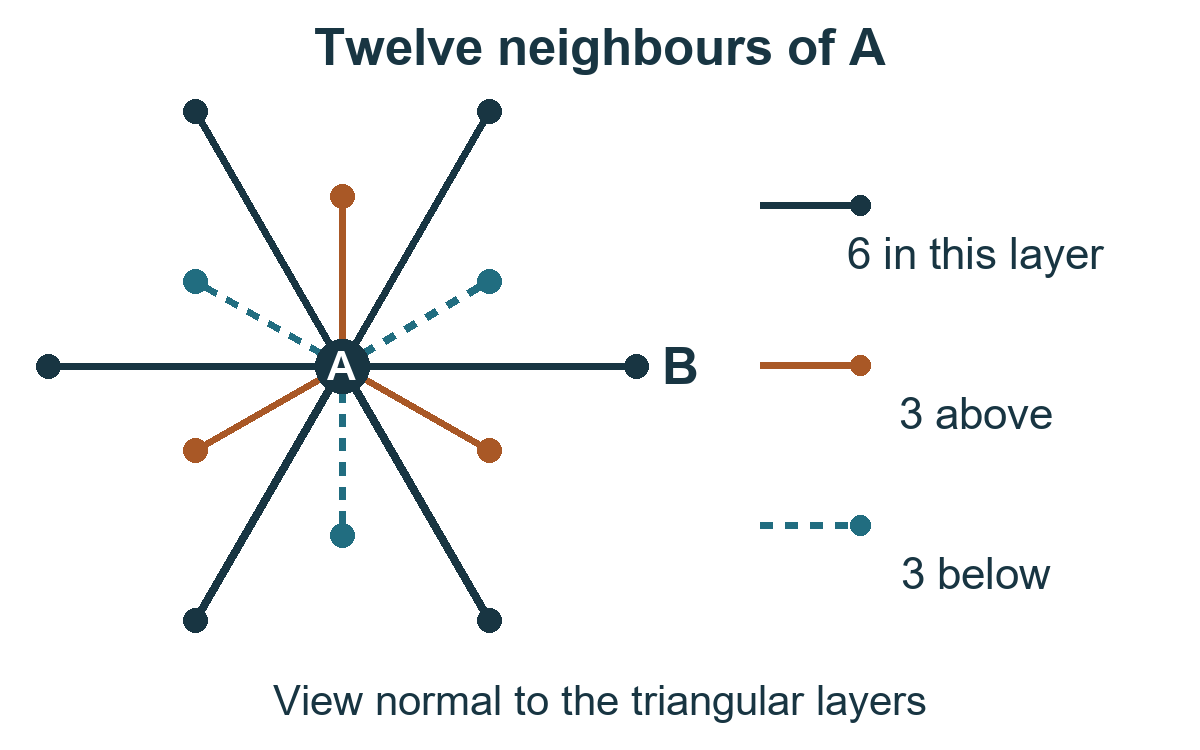
The framework contains both tetrahedral and octahedral spaces. Counting the six edges of one tetrahedron would tell us nothing about the number of wires meeting at a junction.
Find the current in the direct wire
Let \(G\) and \(R_{\mathrm{w}}\) denote the conductance and resistance of one wire. Fourier’s law gives the heat current from junction \(i\) to junction \(j\).
The area is \(2.00\times10^{-4}\,\mathrm{m^2}\) and the length is \(0.100\,\mathrm{m}\). Hence
The wire resistance is \(R_{\mathrm{w}}=1.298701\,\mathrm{K\,W^{-1}}\). The current in the direct wire follows immediately from the given temperature difference.
Other heat can leave \(A\) and reach \(B\) through the rest of the network. At any junction without an external source or sink, the sum of the outward currents is zero. If \(j\) runs over the twelve neighbours of \(i\), this gives
Use symmetry to find the total current
The junction equations are linear. We can therefore add two auxiliary temperature fields and their corresponding heat currents. For temperature, add the deviations from the same distant reference temperature and restore that reference once.
A source at the hot junction. Supply heat at rate \(P\) at \(A\) and remove it at infinity. In this state no sink singles out \(B\). The twelve wires leaving \(A\) are equivalent, so each carries \(P/12\) away from \(A\). In particular, the current through \(AB\) is \(P/12\) toward \(B\).
A sink at the cold junction. Remove heat at rate \(P\) at \(B\) and supply it from infinity. Now no source singles out \(A\). Each of the twelve wires at \(B\) carries \(P/12\) inward. The current through \(AB\) again points from \(A\) to \(B\).
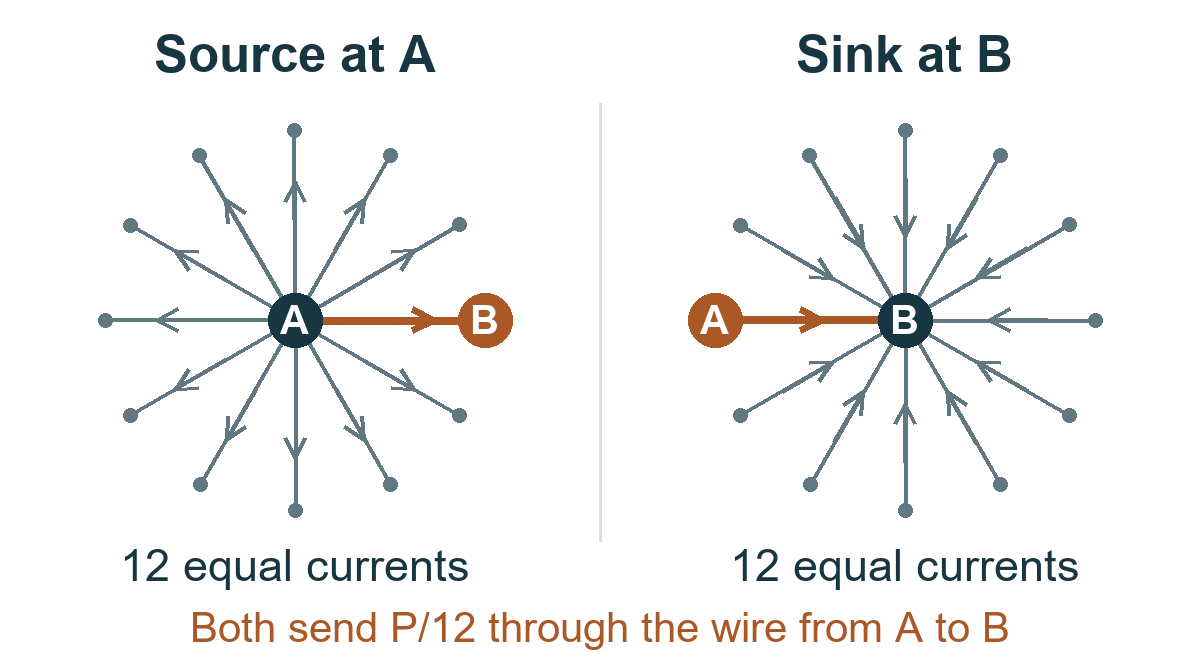
Adding the two fields leaves a source of power \(P\) at \(A\) and a sink of the same power at \(B\). The distant supply and removal cancel in the infinite-lattice limit. Both contributions in the direct wire have the same direction, so
Combining this result with the direct-wire calculation gives the total heat supplied by the hot reservoir.
The factor six follows from the twelve equivalent directions and the two contributions through \(AB\). Equal splitting applies in the separate source or sink states. In the actual two-reservoir state, the outgoing currents at \(A\) are generally unequal.
The effective resistance between the two adjacent junctions is
| Quantity | Expression | Result |
|---|---|---|
| Resistance of one wire | \(R_{\mathrm{w}}=\ell/(kS)\) | \(1.298701\,\mathrm{K\,W^{-1}}\) |
| Resistance of the full network | \(R_{\mathrm{eff}}=R_{\mathrm{w}}/6\) | \(0.216450\,\mathrm{K\,W^{-1}}\) |
| Total heat supplied at \(A\) | \(P=6G\Delta T\) | \(4.620\,\mathrm{W}\) |
| Heat through the direct wire | \(q_{AB}=G\Delta T\) | \(0.770\,\mathrm{W}\) |
| Heat through all other routes | \(P-q_{AB}\) | \(3.850\,\mathrm{W}\) |
A temperature difference of \(1\,{}^\circ\mathrm{C}\) equals \(1\,\mathrm{K}\). Only differences enter these equations because the conductivity is constant and radiation is neglected.
Further challenge
Cut only the direct wire \(AB\). Find the new heat current if the reservoirs maintain \(\Delta T=1.00\,\mathrm{K}\). Then find the required temperature difference if the original power \(P=4.620\,\mathrm{W}\) is maintained instead.
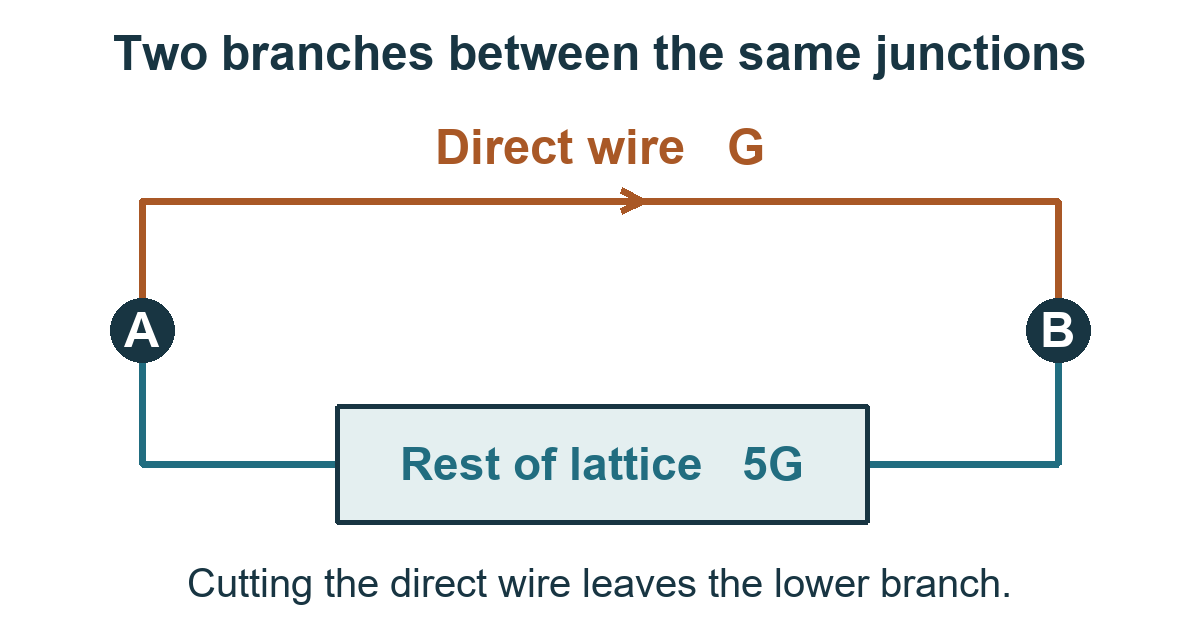
The direct wire and the whole remaining network have the same two endpoints. For a given \(\Delta T\), their heat currents add, so their conductances add. Before the cut, the full network has conductance \(6G\) and the direct wire has conductance \(G\). The conductance of the remaining network is therefore
Fixed temperature difference. The two endpoint temperatures are unchanged. Every other junction in the remaining network obeys the same balance equation as before, so its temperature is unchanged too. The new total current is
Fixed power. With the smaller conductance, a larger temperature difference is required to carry the same power.
Cutting the wire breaks the symmetry that made all twelve directions equivalent. Replacing twelve by eleven in the original equal-splitting argument would therefore give the wrong result.