
Maximum Wind Power
Before you begin
You should know blackbody radiation, steady energy balance and Carnot efficiency. The precise maximum uses differentiation; trial values give the requested one-significant-figure estimate.
How much absorbed starlight can an ideal heat engine between a planet’s day and night sides convert into captured wind power? A colder night side raises the engine’s efficiency, but also reduces the heat it can accept. We will find the balance that gives the greatest power.
The problem
A spherical planet of radius \(R\) always presents the same face to a star of radius \(R_s\) and temperature \(T_s\). Their centres are separated by \(R_0\), much greater than either radius. The incident rays are parallel across the planet.
The day hemisphere has uniform temperature \(T_{\mathrm{h}}\) and the night hemisphere has uniform temperature \(T_{\mathrm{c}}\). Both temperatures are steady in each chosen operating state, but may change between states. Treat the star and planet as blackbodies, and the surrounding space as \(0\,\mathrm{K}\).
The hemispheres act as the hot and cold reservoirs of an ideal reversible engine. All heat transferred between them passes through the engine. Its work appears as wind power \(P_{\mathrm{w}}\), which is immediately captured and stored without reheating the planet.
For a blackbody of area \(A\),
Part a. Express the absorbed stellar power \(P\) in terms of \(R\), \(R_s\), \(R_0\), \(T_s\) and \(\sigma\).
Part b. Determine the limiting range of \(x=T_{\mathrm{c}}/T_{\mathrm{h}}\). Find the wind power at each endpoint.
Part c. Obtain \(P_{\mathrm{w}}/P\) as a function of \(x\) alone.
Part d. Estimate the largest possible fraction \(P_{\mathrm{w}}/P\) to one significant figure, with justification. We will also find a more precise optimum.
Part a The intercepted stellar power
The star emits uniformly over its spherical surface. Its luminosity is
At the planet’s orbit, this power is spread over a sphere of radius \(R_0\). The irradiance is therefore
The planet intercepts a beam with cross-sectional area \(\pi R^2\), so
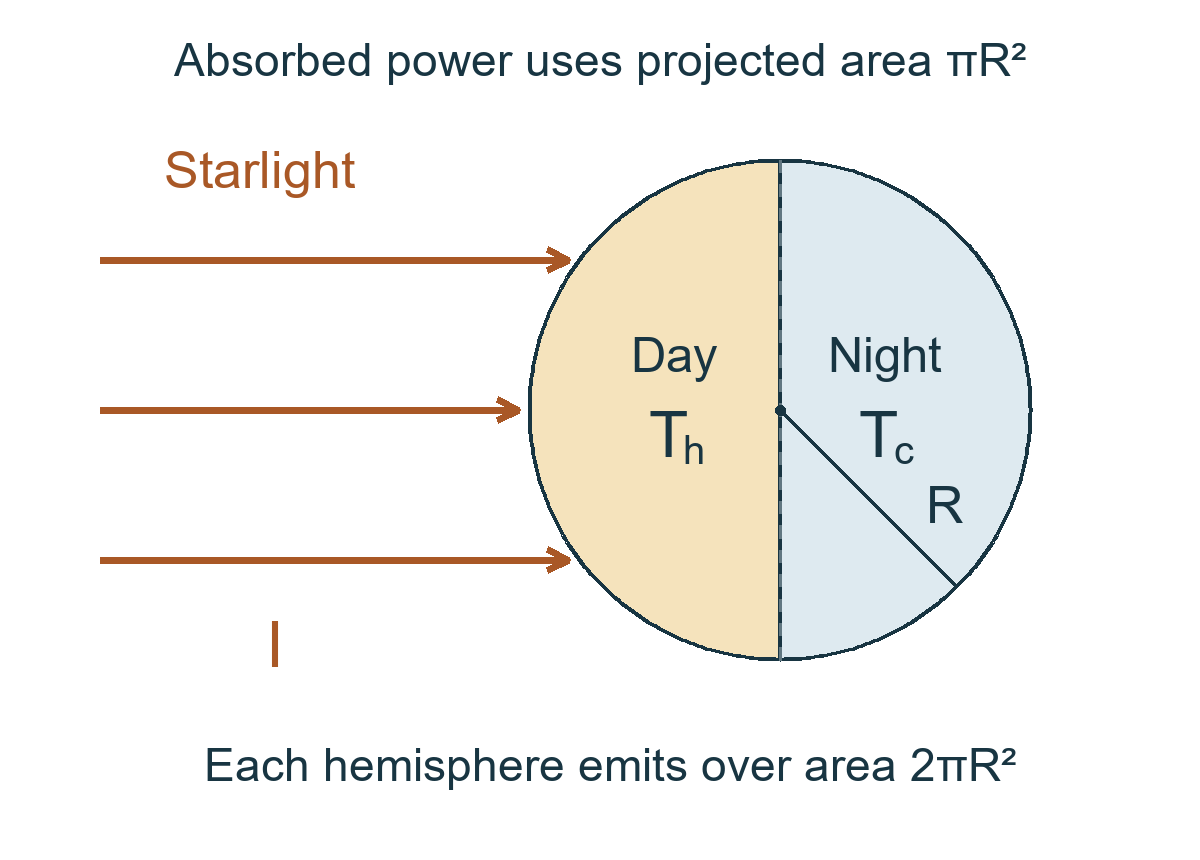
The day hemisphere has surface area \(2\pi R^2\), but oblique sunlight supplies less power per unit area away from the point facing the star. The projected area determines absorption. Each hemisphere emits over its full curved area \(2\pi R^2\).
Set up the three energy balances
Define \(C=2\pi R^2\sigma\), with units \(\mathrm{W\,K^{-4}}\). Let \(\dot{Q}_{\mathrm{h}}\) be the heat rate entering the engine and \(\dot{Q}_{\mathrm{c}}\) the heat rate leaving it. Dots denote energy per unit time.
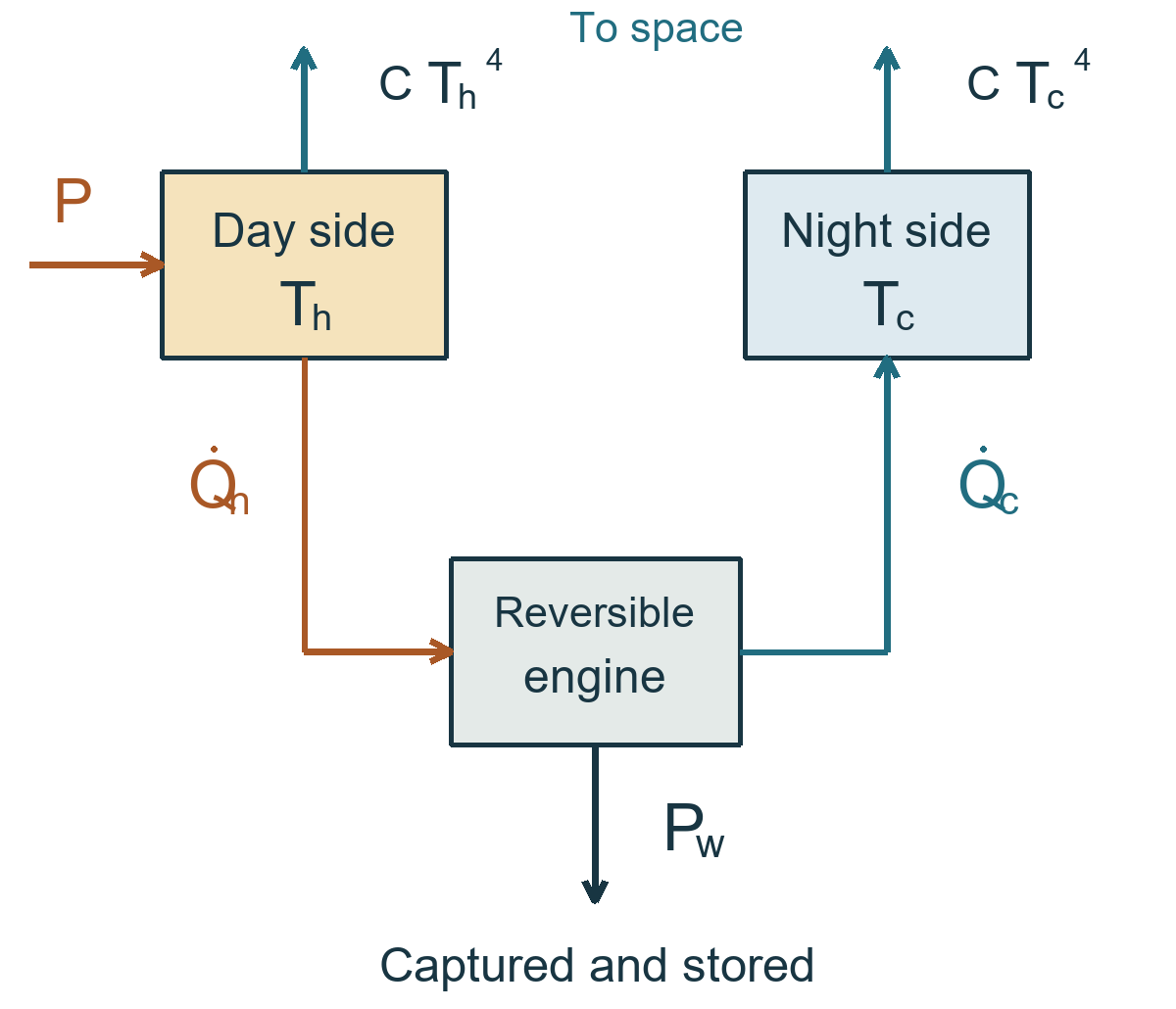
The steady balances for the hot hemisphere and cold hemisphere are
For the engine,
A reversible engine operating between positive absolute temperatures obeys
Whenever the engine produces work, it transfers less heat to the cold side than it removes from the hot side.
Part b The two limiting cases
A work-producing engine requires \(T_{\mathrm{h}}>T_{\mathrm{c}}>0\). Including the ideal endpoint limits gives \(0\leq x\leq1\).
A very cold night side
The night side receives no sunlight, so its radiation determines how much heat it can accept. Combining its balance with reversibility gives
As \(x\) tends to zero, the night-side temperature tends to zero. Both heat rates and \(P_{\mathrm{w}}\) then tend to zero. The day side radiates all the absorbed power, with \(T_{\mathrm{h}}\to(P/C)^{1/4}\).
The limiting Carnot efficiency approaches one, but the engine’s heat input approaches zero. There is no finite-power engine operating with a \(0\,\mathrm{K}\) reservoir in this model.
Nearly equal temperatures
As \(x\) tends to one, the engine efficiency tends to zero. With both temperatures equal to \(T\), the two radiation rates are equal:
Maintaining finite heat flow while the driving temperature difference tends to zero would require unbounded thermal conductance. This endpoint is an ideal limit.
Part c The wind power for any ratio
For \(0<x<1\), put \(T_{\mathrm{c}}=xT_{\mathrm{h}}\) into the cold-side balance and the reversible-engine relation:
The hot-side balance fixes its temperature:
Subtracting the rejected heat rate from the supplied heat rate gives
Eliminate the hot-side temperature to obtain
Both endpoint limits give zero, as required. The denominator accounts for the day-side temperature adjustment when the operating state changes.
Part d Find the maximum
Write the power fraction as \(f(x)\). Differentiation gives
An interior maximum satisfies
The numerator factor \(3-4x-x^4\) decreases strictly from \(3\) to \(-2\) as \(x\) runs from zero to one. Thus the derivative changes sign exactly once, from positive to negative. Together with the zero endpoint values, this proves that the maximum is unique and global.
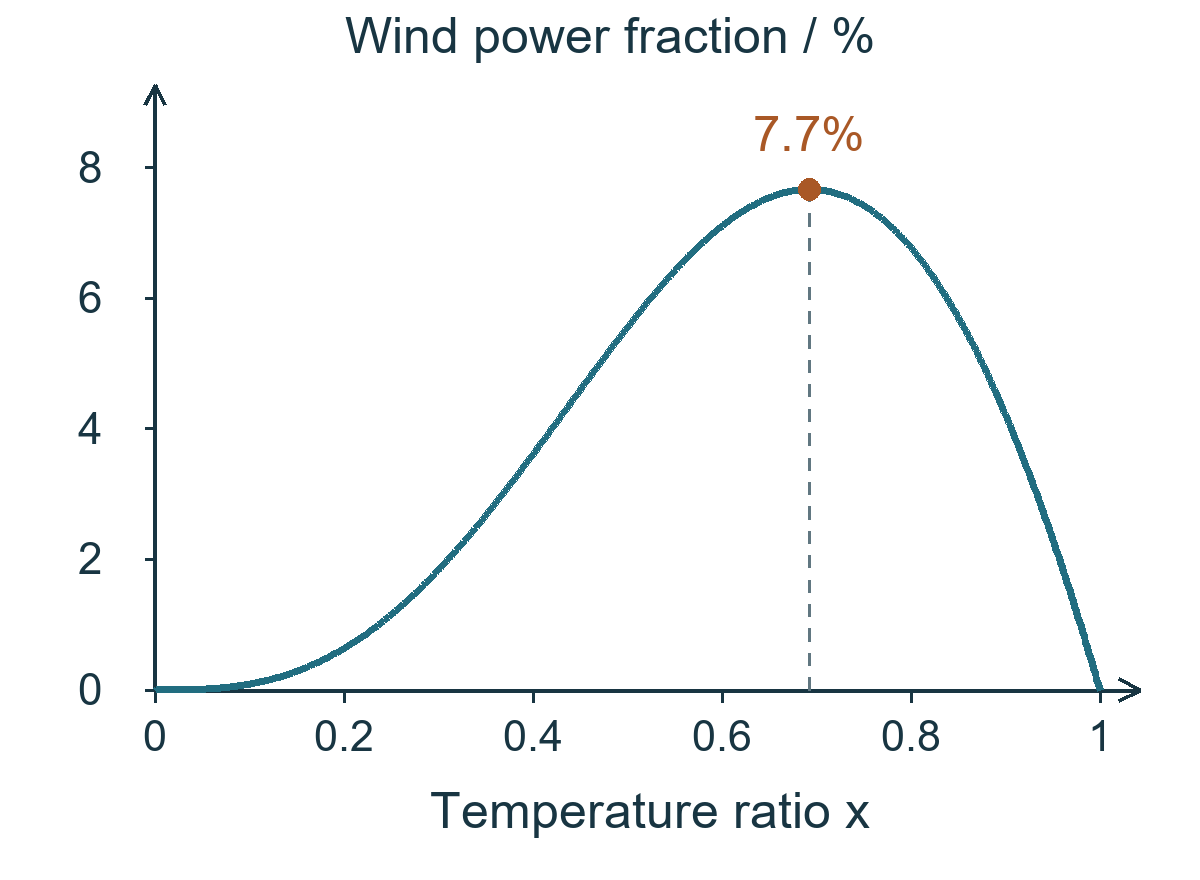
The maximum is about \(7.7\%\). To the one significant figure requested, it is \(P_{\mathrm{w,max}}\simeq0.08P\), or \(8\%\).
Estimate without solving the quartic
Trial ratios \(x=0.50\), \(0.70\) and \(0.90\) give power fractions \(0.0556\), \(0.0766\) and \(0.0422\), respectively. A sketch and a few nearby trials place the peak close to \(0.70\), enough for the requested estimate. The derivative argument also proves that this is the only peak.
An algebraic check. At the optimum, \(x_*^4=3-4x_*\). Using this relation in the power expression gives
Why the maximum is small
The engine efficiency and the fraction of absorbed starlight converted into work have different denominators:
The first factor is the fraction entering the engine; the second is its efficiency. At the optimum, only about one quarter of the incoming stellar power reaches the engine. The rest is radiated directly by the day hemisphere. The engine converts about \(30.75\%\) of its own input into work.
| Energy flow at the optimum | Fraction of \(P\) | Percentage |
|---|---|---|
| Radiation from the day side | \(1/(1+x_*^3)\) | \(75.0695\%\) |
| Heat entering the engine | \(x_*^3/(1+x_*^3)\) | \(24.9305\%\) |
| Heat rejected and radiated at night | \(x_*^4/(1+x_*^3)\) | \(17.2645\%\) |
| Captured wind power | \(x_*^3(1-x_*)/(1+x_*^3)\) | \(7.6660\%\) |
The first two rows add to \(100\%\), and the last two add to the second row. For the whole planet, the two radiation rates plus captured wind power equal the incident power. The engine input is an internal flow; do not count it again as an output.
The temperatures must adjust together
For a fixed star and orbit, \(P\) is fixed. Once \(x\) is chosen, both temperatures follow from the balances:
We cannot maximise the work rate while treating the engine heat input as an independent constant. Making the night side colder reduces its radiation and the heat rate it can accept. This also limits how much heat the reversible engine can draw from the day side.
Points to remember
Use \(\pi R^2\) for intercepted starlight and \(2\pi R^2\) for radiation from each hemisphere.
Use absolute temperatures in the fourth-power radiation law and the engine efficiency.
Keep the two engine heat rates distinct; their difference is the captured work rate.
Apply the Carnot factor to heat entering the engine, not to all the absorbed starlight.
The \(7.7\%\) result belongs to this ideal two-temperature model. It is not a prediction for Earth’s actual wind power. Only the engine is reversible; the whole star–planet radiation process is not assumed reversible.