
Four Particles in Cyclic Pursuit
Before you begin
You should know relative velocity, vector components, plane geometry and differentiation. The complete proof also uses first-order separable equations. Follow the perimeter calculation first, then read the proof that makes its conclusion valid.
Four particles continually chase their next neighbours. Their shape changes, but symmetry and relative velocity reveal an exact collision time. We will close the gap in the perimeter argument by ruling out every earlier collision, then examine acceleration, a decreasing common speed and a uniform current.
The problem
Four point particles start simultaneously at the vertices of a rectangle \(ABCD\), labelled counterclockwise. Initially, \(AB=CD=a\) and \(BC=DA=b\), where \(a,b>0\). Each moves at the same constant speed \(v>0\). At every instant, \(A\) heads directly toward the current position of \(B\), \(B\) toward \(C\), \(C\) toward \(D\), and \(D\) toward \(A\).
Motion is on an unobstructed plane. The particles may turn as rapidly as the rule requires; there is no acceleration limit. A collision means coincidence of two positions, and we study the motion up to its first collision.
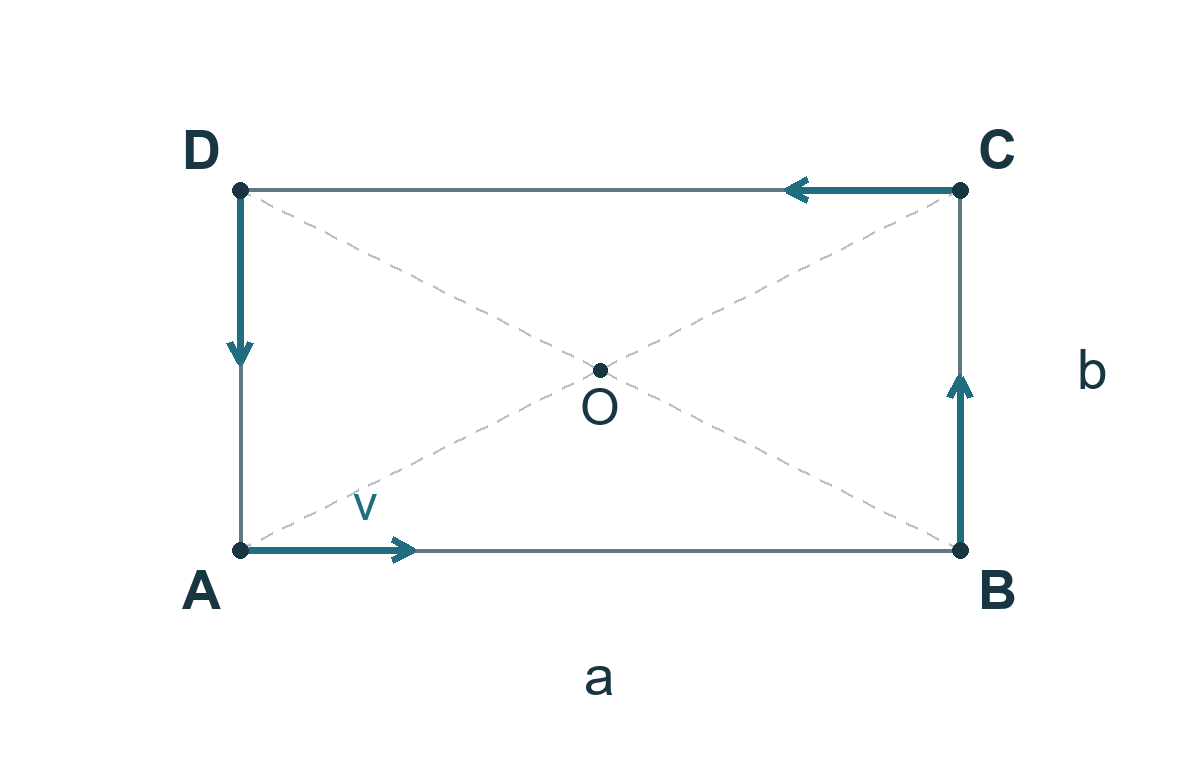
Original task. When does a collision occur for a \(2\) by \(1\) rectangle at unit speed? Use \(a=2\ \mathrm{m}\), \(b=1\ \mathrm{m}\) and \(v=1\ \mathrm{m\,s^{-1}}\) for the dimensional version here.
Added challenges. Derive the result for arbitrary \(a,b,v\). Find the meeting point and the distance travelled by each particle. Prove that an earlier two-particle collision cannot invalidate your answer.
The symmetry that survives the chase
Let \(O\) be the initial diagonal intersection. Opposite particles start at opposite positions about \(O\). Their pursuit rules are identical under a rotation by \(180^{\circ }\), so this central symmetry persists until a collision. Their velocities remain opposite:
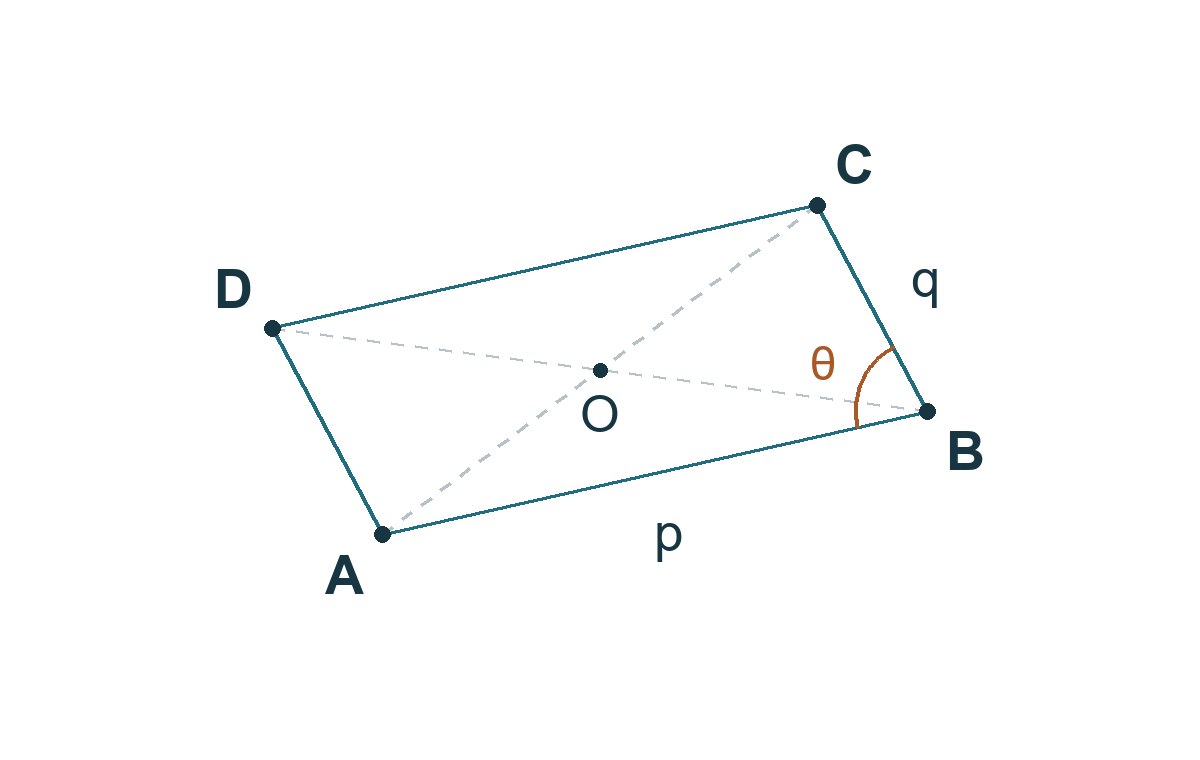
Consequently, both opposite-pair midpoints remain fixed at \(O\). The four positions form a parallelogram, although its angles need not remain right angles.
Write \(p=AB=CD\), \(q=BC=DA\) and \(\theta=\angle ABC\), with \(0<\theta<\pi\) before degeneration.
Project the relative velocities along the sides
The rate of change of a distance is the component of relative velocity along the line joining the particles. Along \(AB\), particle \(A\) contributes \(v\) forward; particle \(B\) contributes \(v\cos \left( \pi-\theta \right)=-v\cos \theta\). Thus
Along \(BC\), the projection of \(\vec{v}_{C}\) is \(v\cos \theta\), while \(B\) contributes \(v\). Therefore
The angle-dependent terms cancel on addition:
The perimeter would vanish at \(T_{0}=\left( a+b \right)/(2v)\). This identifies the possible complete-collapse time. We must still rule out a collision before \(T_{0}\); that is the subtle part of the problem.
Two identities needed for a complete proof
The following steps use only velocity components, differentiation and separation of variables. They will let us prove that the perimeter law remains valid all the way to the first collision.
How fast do the sides turn
Let \(\phi\) and \(\psi\) be the continuously followed directions of \(AB\) and \(BC\), measured counterclockwise from a fixed axis. Their difference is the exterior angle:
For a segment of length \(p\), a small transverse relative displacement \(v_{\perp }\, dt\) changes its direction by \(d\phi=v_{\perp }\, dt/p\). Here both segments have transverse relative speed \(v\sin \theta\), so
Differentiating the angle relation gives
These are rates of change of the side directions. They should not be confused with the angular velocities of the particles about \(O\).
How fast does the area change
Let \(K=pq\sin \theta\) be the parallelogram’s area. Logarithmic differentiation, followed by substitution of the three rates, gives
Thus
The area decreases while \(K>0\). More importantly, if \(p\) and \(q\) remain bounded away from zero on a finite interval, the coefficient multiplying \(K\) stays bounded.
A useful positivity fact
If \(f\left( t_{1} \right)>0\) and \(\dot{f}=-h(t)f\), separation of variables gives
When \(h\) is bounded over a finite interval, the integral is finite and the exponential remains strictly positive. A positive \(f\) cannot reach zero there. This simple fact will close the logical gap in the perimeter argument.
Why no pair can collide early
Suppose the first collision or flattening occurs at \(t_{*}<T_{0}\). Then
Both side lengths cannot vanish together at this earlier time. There are only three possibilities.
Both side lengths remain positive
The coefficient \(v\left(1/p+1/q\right)\) is bounded near \(t_*\). The area identity and the positivity fact therefore prevent \(K\) from reaching zero.
A flattened parallelogram has zero area. A meeting of opposite vertices also makes the area zero. Hence neither event can occur while both adjacent side lengths stay positive.
One adjacent side tends to zero
Suppose \(p\to 0\) while \(q\) tends to a positive value. Introduce
Using the side and angle rates,
Substituting and collecting the common factor \(F\) gives
Since \(q\) stays positive and \(0\leq 1+\cos \theta\leq 2\), this coefficient remains bounded near \(t_{*}\). Therefore \(F\) must retain a positive limiting value. But \(0<F\leq 2p\to 0\), a contradiction.
If instead \(q\to 0\) while \(p\) stays positive, use
The same reasoning contradicts \(0<G\leq 2q\to 0\). This excludes the remaining adjacent-pair collision.
Complete the argument and answer the original question
No earlier collision is possible. As \(t\to T_{0}\), \(p+q\to 0\). The distance of any vertex from \(O\) is at most \(\left( p+q \right)/2\), by the triangle inequality for a half-diagonal. All four therefore reach \(O\) together:
For \(a=2\ \mathrm{m}\), \(b=1\ \mathrm{m}\) and \(v=1\ \mathrm{m\,s^{-1}}\), the first collision is at \(T=1.5\ \mathrm{s}\), at the initial diagonal intersection. Each particle travels \(1.5\ \mathrm{m}\). The changing shape does not alter these exact results.
Initial turning and acceleration
Question. For the initial rectangle, determine whether the right angle at \(B\) starts increasing or decreasing. Find all four initial acceleration vectors. Take \(+x\) along \(AB\) and \(+y\) along \(BC\).
At \(t=0\), \(p=a\), \(q=b\) and \(\theta=\pi/2\). Hence
For the \(2\) by \(1\) example, \(\dot{\theta}(0)=-0.5\ \mathrm{rad\,s^{-1}}\): the angle initially decreases. This already disproves the assumption that a nonsquare rectangle remains rectangular. The angle need not decrease throughout the entire chase.
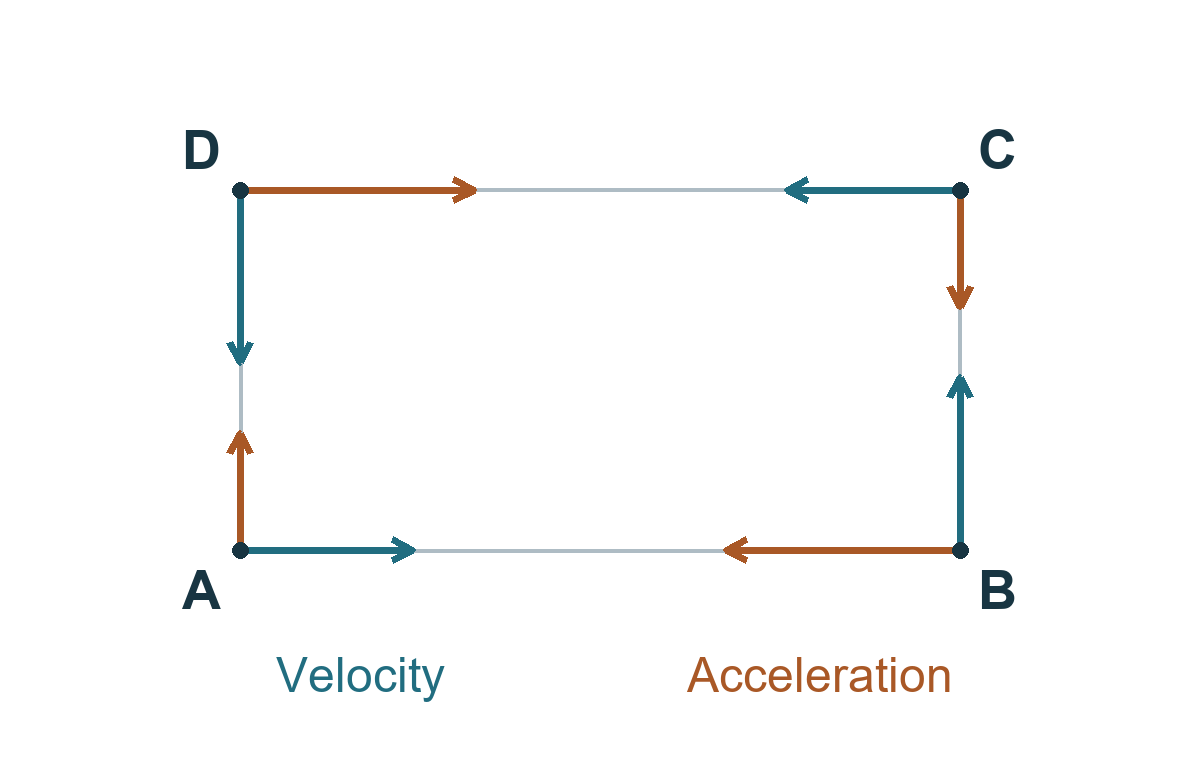
The speed of \(A\) is constant, but its heading turns at \(\dot{\phi}=v/a\). A velocity vector of fixed magnitude \(v\) turning at rate \(\omega\) has perpendicular acceleration of magnitude \(v\omega\). Thus
In the numerical example, \(A,C\) initially have acceleration magnitude \(0.5\ \mathrm{m}/\mathrm{s}^{2}\), while \(B,D\) have magnitude \(1.0\ \mathrm{m}/\mathrm{s}^{2}\).
A further check using the area
Initially \(K=ab\) and \(\sin \theta=1\), so
for the numerical example. Constant particle speed does not imply constant acceleration, constant angle or constant area-loss rate. Only the perimeter-loss rate is constant in this model.
Checks that do not require the full paths
The collision proof does not require the full trajectories. These calculated paths illustrate the changing shape in the \(2\) by \(1\) example.
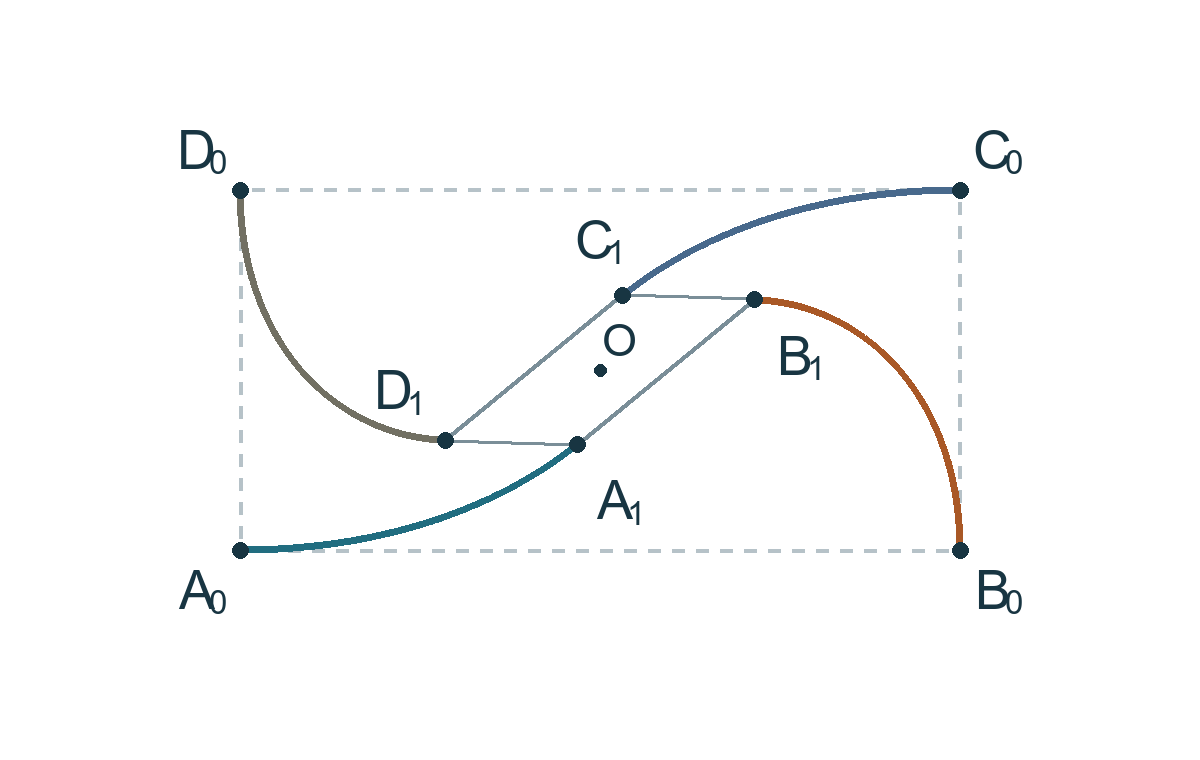
The plot preserves central symmetry and gives the required perimeter at \(t=1.00\ \mathrm{s}\):
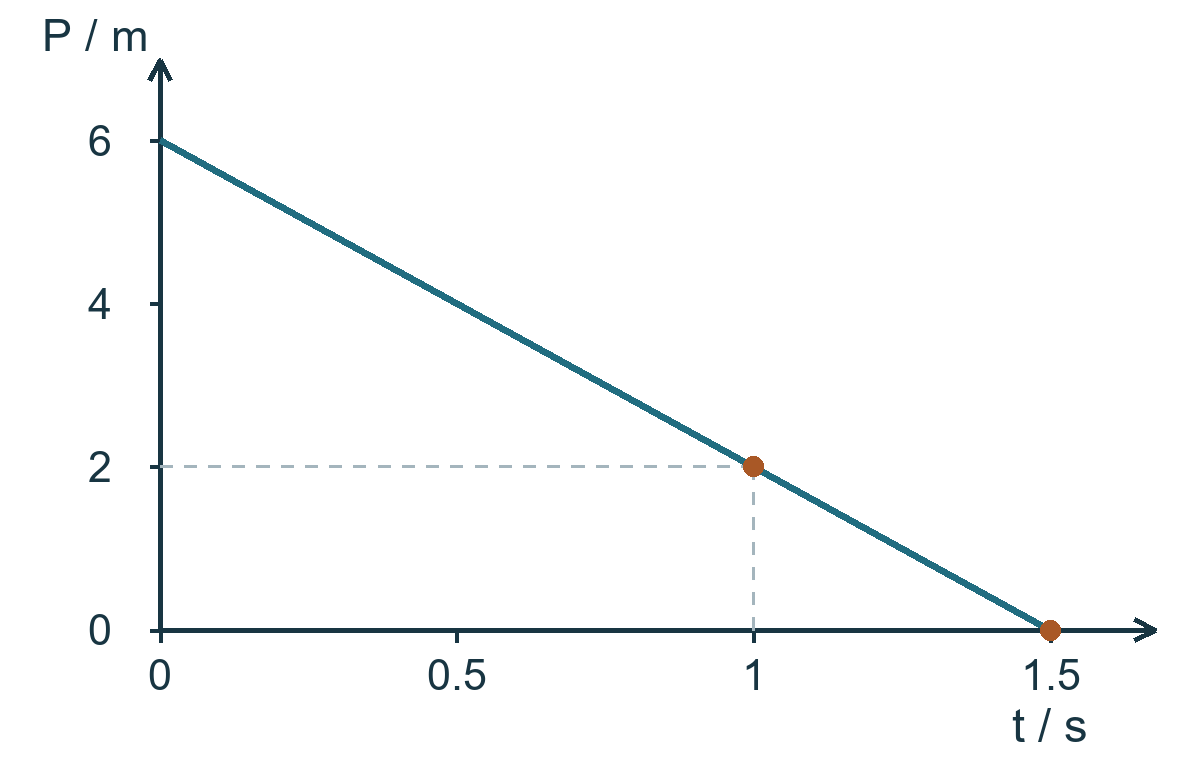
Compare distance travelled with displacement
Every initial vertex lies a distance \(\sqrt{a^{2}+b^{2}}/2\) from \(O\). Therefore
The common path length is \(1.5\ \mathrm{m}\), while the displacement magnitude is \(\sqrt{5}/2\simeq 1.11803\ \mathrm{m}\). The longer path is consistent with the continually changing heading.
A common decreasing speed
Question. Suppose all four particles still obey the same pursuit rule, but their common speed is now a continuous function \(w(t)\geq 0\). Obtain a capture criterion. Then analyse
All side and angle rates acquire the same factor \(w(t)\) in place of \(v\). Define the distance travelled by each particle up to time \(t\):
The perimeter is
The shape evolves through the same configurations as before when parametrised by \(\Lambda\) instead of time. Capture occurs when the common travelled distance first reaches
For the exponential speed,
Three different outcomes follow.
| Available total path length | Outcome |
|---|---|
| \(v_0\tau>(a+b)/2\) | Capture at a finite time |
| \(v_0\tau=(a+b)/2\) | All approach \(O\), but meet only in the limit \(t\to\infty\) |
| \(v_0\tau<(a+b)/2\) | No capture; the final perimeter is positive |
In the first case,
For \(a=2\ \mathrm{m}\), \(b=1\ \mathrm{m}\) and \(v_{0}=1\ \mathrm{m\,s^{-1}}\):
| \(\tau\) | Checked conclusion |
|---|---|
| \(2.0\,\mathrm{s}\) | \(T=2\ln4\,\mathrm{s}\simeq2.772589\,\mathrm{s}\) |
| \(1.5\,\mathrm{s}\) | Separation tends to zero only as \(t\to\infty\) |
| \(1.0\,\mathrm{s}\) | \(P_{\infty}=(6-4)\,\mathrm{m}=2.0\,\mathrm{m}\); no capture |
Slowing all particles by the same factor changes the clock, but not the sequence of shapes. Equality in the total-distance criterion needs careful treatment.
Pursuit in a uniform current
Question. Return to constant speed \(v=1\ \mathrm{m\,s^{-1}}\) relative to the surrounding water. Suppose the four particles are small powered boats, with the same initial \(2\ \mathrm{m}\) by \(1\ \mathrm{m}\) rectangle. At each instant, each boat directs its velocity relative to the water toward its next neighbour. The water has uniform constant velocity
relative to the bank. Take the initial diagonal intersection as the bank-frame origin. Find the capture time and position. Does the \(1.5\ \mathrm{m}\) path-length result apply in the bank frame?
Use the frame moving with the water
For any boat \(i\), add the current to its water-frame velocity. On subtracting the velocities of two boats, the common current cancels:
Their relative positions and all shape equations are unchanged. The water-frame centre stays fixed, while the bank-frame centre translates as \(\vec{r}_{O}(t)=\vec{U}t\). Therefore
Each boat travels \(1.5\ \mathrm{m}\) relative to the water. Its bank-frame speed is \(|\vec{U}+\vec{v}_{\mathrm{water}}(t)|\), which generally changes as its heading changes. Thus \(vT\) does not give the bank-frame path length.
Final results and useful cautions
| Constant-speed chase | Exact result |
|---|---|
| First collision time | \((a+b)/(2v)\) |
| Meeting point with no current | Initial diagonal intersection |
| Distance travelled by each particle | \((a+b)/2\) |
| Perimeter before capture | \(2(a+b)-4vt\) |
| Initial angle rate at \(B\) for a rectangle | \(v(1/a-1/b)\) |
The collision-time and path-length results apply to any nondegenerate initial parallelogram with adjacent sides \(a,b\). Central symmetry and the complete no-earlier-collision proof are essential. A shrinking perimeter alone would not justify ignoring a possible earlier partial collision.
Sources and further reading
The original collision-time challenge for a 2 by 1 rectangle was set in Trefethen’s October 2008 Oxford Numerical Analysis Problem Solving Squad assignment. It is documented by S. J. Chapman, James Lottes and Lloyd N. Trefethen in Four bugs on a rectangle, PDF page 2. The pursuit equations appear on PDF page 7. The paper was published in Proceedings of the Royal Society A 467, 881–896 (2011), DOI 10.1098/rspa.2010.0506.
The dimensional example, guided no-earlier-collision proof and later challenges are teaching extensions in the supplied document. This article’s explanation and all diagrams are independently prepared. The tools include relative velocity, geometry, differentiation and first-order separable equations. These tools align with the official JEE Advanced 2026 syllabus, but this complete pursuit proof is an advanced extension, not a claim that this specific problem is prescribed.