
Leaky Boiler and Carnot Engine
Before you begin
You should know conduction through a plane slab, steady energy balance, Carnot efficiency and quadratic equations. The maximum is found by differentiation and checked by algebra.
Conduction through the boiler walls reduces the heat reaching a Carnot engine. Find how this heat loss changes the useful power and the best operating temperature.
A hotter engine is more efficient, but a hotter boiler also loses more heat. We will find two temperatures that give the same output, then locate the temperature that gives the greatest useful power.
The problem
A cubic boiler supplies heat to an ideal Carnot engine, which rejects heat to surroundings at a constant temperature \(T_{0}\). The heater supplies a fixed net power \(P_{0}\) through the base. Heat also escapes directly through the four side walls and the roof. The engine drives a mechanical load, and its operation can be adjusted to obtain different steady boiler temperatures.
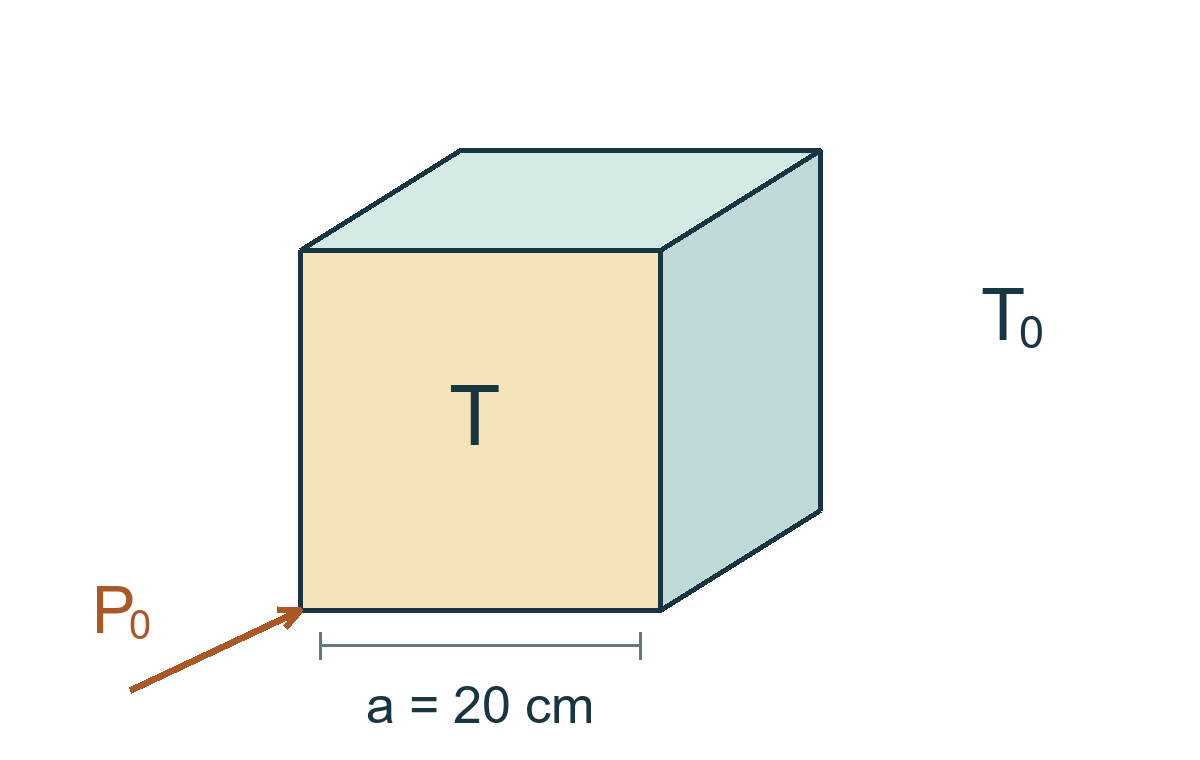
| Quantity | Symbol | Value |
|---|---|---|
| Edge length of the cube | \(a\) | \(20\,\mathrm{cm}\) |
| Thickness of each loss wall | \(d\) | \(1.0\,\mathrm{cm}\) |
| Wall thermal conductivity | \(k\) | \(1.0\,\mathrm{W\,m^{-1}\,K^{-1}}\) |
| Net heater power through the base | \(P_0\) | \(5.0\,\mathrm{kW}\) |
| Surroundings and cold reservoir | \(T_0\) | \(27^{\circ}\mathrm{C}\) |
The boiler interior has a uniform temperature \(T\). Treat each loss wall as a plane slab of area \(a^{2}\), with its inner face at \(T\) and its outer face at \(T_{0}\). Use steady, one-dimensional conduction; neglect edge effects and additional heat losses. For numerical work, use the school approximation \(0^{\circ }\mathrm{C}=273\ \mathrm{K}\).
Find (a) the engine efficiency and mechanical power when the boiler is at \(100^{\circ }\mathrm{C}\).
(b) All boiler temperatures at which the mechanical power is \(500\ \mathrm{W}\).
(c) The greatest mechanical power obtainable, and the corresponding boiler temperature.
Heat balance and engine efficiency
Count the heat loss faces
Heat escapes through five faces, not six. The base supplies the specified net input. Each of the other faces provides a parallel route from \(T\) to \(T_{0}\), so their areas add:
Fourier’s law gives the total wall loss. Define \(G\) as the combined thermal conductance of the five walls:
The corresponding wall resistance is \(1/G=0.050\ \mathrm{K}\,\mathrm{W}^{-1}\). This is a parallel combination of wall resistances; heat does not pass through all five walls in succession.
Separate the two routes to the surroundings
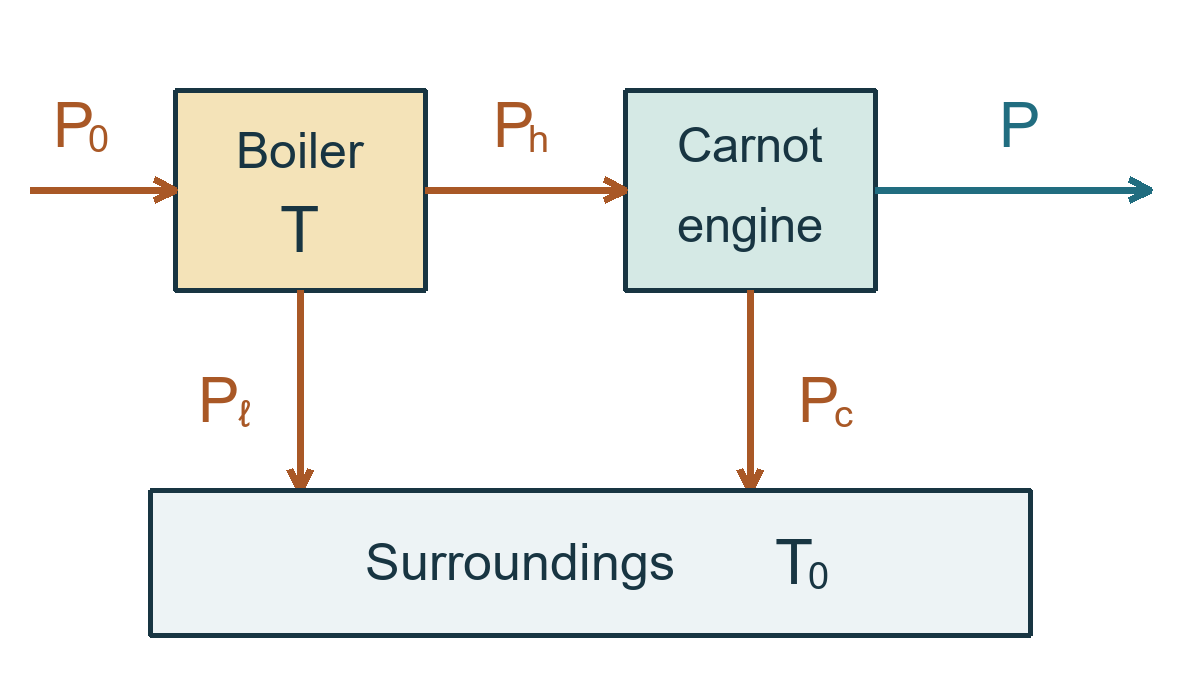
Let \(P_{h}\) be the heat input per second to the engine, \(P_{c}\) its heat rejection per second, and \(P\) its useful mechanical power. Steady energy balance for the boiler gives
For a Carnot engine, use absolute temperatures:
The Carnot factor multiplies the engine’s heat input \(P_{h}\), not the heater power \(P_{0}\).
Part a at 100 degrees Celsius
Here \(T=373\ \mathrm{K}\) and \(T_{0}=300\ \mathrm{K}\). The wall temperature difference is \(73\ \mathrm{K}\):
Thus \(\eta\simeq 19.6\%\) and \(P\simeq 693\ \mathrm{W}\), or \(0.69\ \mathrm{kW}\) to two significant figures. Only \(P/P_{0}=13.9\%\) of the heater input becomes work.
Two temperatures for the same power
Use the temperature rise as the unknown
Put \(x=T-T_{0}\). A difference in kelvin has the same numerical value as a difference in degrees Celsius. Since \(T=T_{0}+x\), the power relation becomes
For the engine to deliver positive power, it must receive heat and be hotter than its cold reservoir:
The two endpoints give zero output for different reasons: at \(x=0\), the Carnot efficiency is zero; at \(x=250\ \mathrm{K}\), all heater power leaks through the walls.
Solve part b without discarding a root
For a specified output \(P\), rearrangement gives
With \(P=500\ \mathrm{W}\), the quadratic formula gives
Thus \(x_{1}=40.69297\ \mathrm{K}\) and \(x_{2}=184.30703\ \mathrm{K}\). Add the outside Celsius temperature, \(27^{\circ }\mathrm{C}\), to these temperature rises:
Both answers are admissible: both rises lie between \(0\) and \(250\ \mathrm{K}\), so each state has positive engine heat input and positive efficiency.
Why the hotter state gives the same output
| Quantity | Cooler state | Hotter state |
|---|---|---|
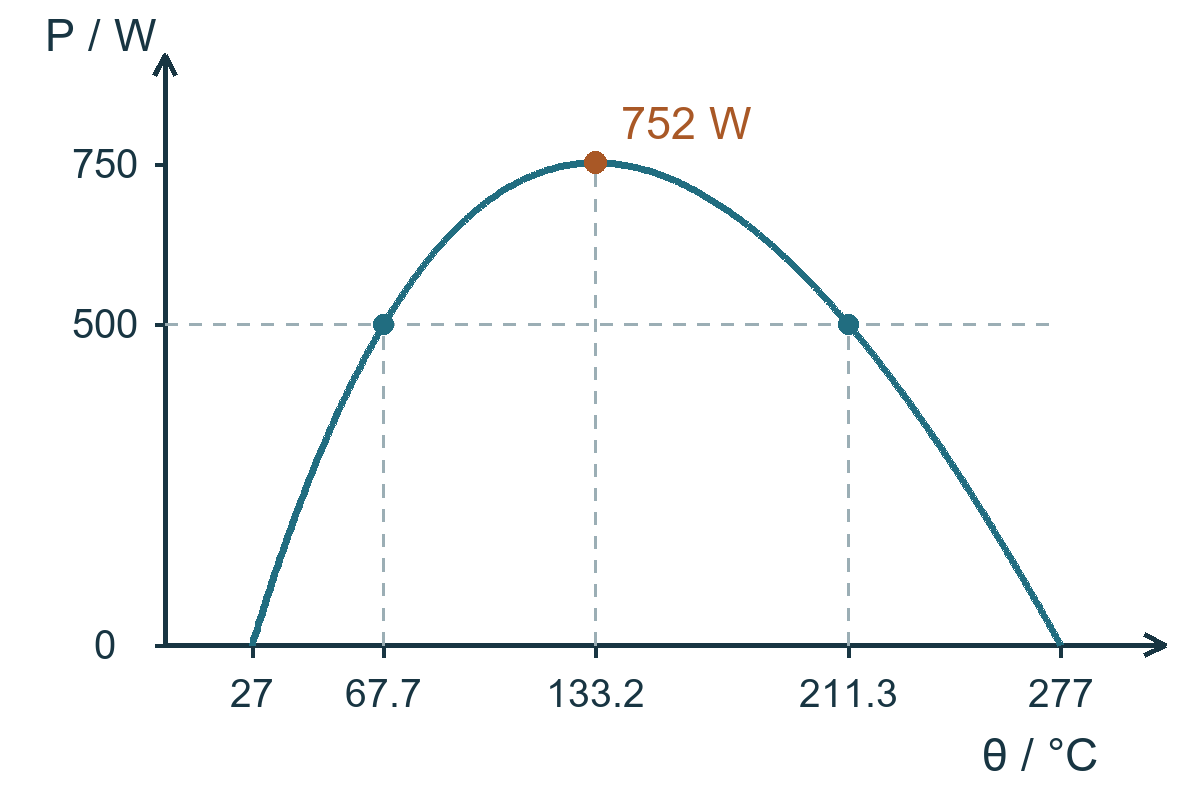
| Boiler temperature | \(67.69^{\circ}\mathrm{C}\) | \(211.31^{\circ}\mathrm{C}\) |
| Direct wall loss \(P_{\ell}\) | \(813.86\,\mathrm{W}\) | \(3686.14\,\mathrm{W}\) |
| Engine heat input \(P_h\) | \(4186.14\,\mathrm{W}\) | \(1313.86\,\mathrm{W}\) |
| Carnot efficiency \(\eta=P/P_h\) | \(11.94\%\) | \(38.06\%\) |
| Useful mechanical power \(P\) | \(500\,\mathrm{W}\) | \(500\,\mathrm{W}\) |
The cooler engine converts a smaller fraction of a larger heat input into work. The hotter engine converts a larger fraction of a smaller heat input. These effects give the same output at two different temperatures. The question concerns adjustable steady operating states; their response to a disturbance would require a separate control model.
The greatest mechanical power
Find the peak of the power function
Define the limiting boiler temperature \(T_{\mathrm{lim}}\) as the temperature at which wall leakage alone consumes the entire heater input:
Then \(P_{h}=G\left( T_{\mathrm{lim}}-T \right)\), so the useful power can be written as
This form separates two competing temperature terms. Differentiating with respect to \(T\) gives
The derivative is positive below \(\sqrt{T_{0}T_{\mathrm{lim}}}\) and negative above it. Therefore there is one maximum within the allowed interval \(T_{0}<T<T_{\mathrm{lim}}\):
Substituting this temperature gives a useful general result:
Part c: the greatest output is about \(752\ \mathrm{W}\), at a boiler temperature of about \({133.2}^{\circ }\mathrm{C}\). This is well below the temperature \(277^{\circ }\mathrm{C}\) at which the wall loss would consume all \(5.0\ \mathrm{kW}\).
An algebraic method using the two roots
The official solution uses the quadratic from part b. As the requested output rises, its two physical temperature roots approach one another. At the maximum they coincide, so the discriminant is zero:
Solving this quadratic in \(P\) gives
The plus sign gives a power larger than the heater input and a negative value of the double temperature-rise root \(x=\left( P_{0}-P \right)/(2G)\). It is physically inadmissible. The minus sign gives \(751.92319\ \mathrm{W}\), agreeing with the calculus result.
The maximum can also be checked without solving a quadratic: for positive \(T\), the arithmetic-geometric mean inequality gives \(T+T_{0}T_{\mathrm{lim}}/T\geq 2\sqrt{T_{0}T_{\mathrm{lim}}}\), with equality precisely at \(T=T_{*}\).
Physical checks and conclusions
Check where the full heater power goes
At the maximum, the temperature rise is \(106.20192\ \mathrm{K}\). Hence
The engine rejects \(P_{c}=P_{h}-P_{\mathrm{max}}=2124.0384\ \mathrm{W}\). Consequently the complete energy balance is
Equal wall leakage and engine heat rejection emerge at the optimum; this was not assumed. The Carnot efficiency is \(26.1\%\), while \(15.0\%\) of the heater input becomes work.
Answers at a glance
| Part | Result |
|---|---|
| a | \(\eta\simeq19.6\%\) and \(P\simeq693\,\mathrm{W}\) |
| b | \(\theta\simeq67.7^{\circ}\mathrm{C}\) or \(211.3^{\circ}\mathrm{C}\) |
| c | \(P_{\mathrm{max}}\simeq752\,\mathrm{W}\) at \(\theta_*\simeq133.2^{\circ}\mathrm{C}\) |
Points to remember
The five loss faces provide parallel conduction paths.
Use kelvin in temperature ratios; kelvin and Celsius differences are numerically equal.
Apply Carnot efficiency to \(P_{h}=P_{0}-P_{\ell }\), and check each root’s physical range.
Increasing efficiency can accompany decreasing useful power.
Sources and further reading
The problem is adapted from the 59th Slovenian High-School Physics Competition, national round, 24 April 2021, Group III, Problem 4. The numerical data are retained, and the explanation and all three diagrams are independently prepared. DMFA question and official solution, PDF pages 7 and 21.
Source check: The question gives \(d=1.0\ \mathrm{cm}\). The official solution header prints \(1.0\ \mathrm{dm}\), but its calculations use centimetres. This handout follows the question and rounds only at the end. Extra digits support checking; the final results agree with the official rounded answers.