
Radiation in a Spherical Thermos
Before you begin
You should know the Stefan–Boltzmann law, thermal equilibrium, the area and volume of a sphere, and latent heat. The final check uses an infinite geometric series.
A vacuum removes conduction through the gap, but radiation still carries energy between the walls. We will account for every reflection, find the heat entering the liquid nitrogen, and use that heat input to calculate when all the liquid has evaporated.
The problem
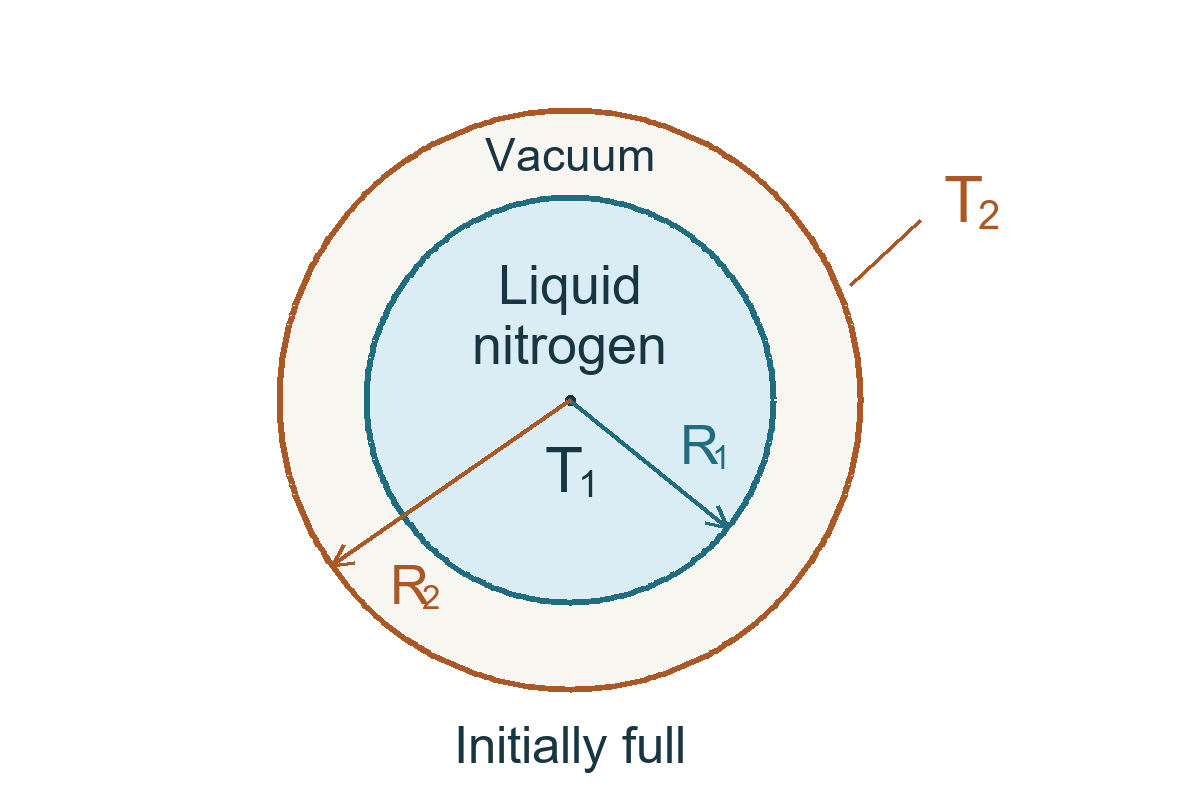
An ideal flask consists of two thin concentric spherical vessels. The inner vessel is initially full of liquid nitrogen. A small valve lets vapour escape at constant pressure. The outer wall stays at temperature \(T_2\). While any liquid remains, the complete inner wall stays uniform at the boiling temperature \(T_1\).
| Quantity | Symbol | Value |
|---|---|---|
| Inner and outer radii | \(R_1,\ R_2\) | \(7.0\,\mathrm{cm},\ 10.0\,\mathrm{cm}\) |
| Inner and outer wall temperatures | \(T_1,\ T_2\) | \(77\,\mathrm{K},\ 293\,\mathrm{K}\) |
| Emissivity of each facing surface | \(\varepsilon\) | \(0.10\) |
| Stefan–Boltzmann constant | \(\sigma\) | \(5.67\times10^{-8}\,\mathrm{W\,m^{-2}\,K^{-4}}\) |
| Liquid nitrogen density | \(\rho\) | \(810\,\mathrm{kg\,m^{-3}}\) |
| Molar latent heat of vaporization | \(L_m\) | \(5580\,\mathrm{J\,mol^{-1}}\) |
| Nitrogen molar mass | \(M\) | \(0.0280\,\mathrm{kg\,mol^{-1}}\) |
The gap is a vacuum. Treat both facing surfaces as opaque diffuse grey surfaces. Each absorbs a fraction \(\varepsilon\), reflects a fraction \(1-\varepsilon\), and transmits no radiation. These properties are independent of wavelength. Each surface emits power \(\varepsilon\sigma T^4\) per unit area.
Neglect heat leaks through the supports and valve, and energy stored in the walls. Ignore wall thickness when finding areas and capacity. All net heat entering the inner vessel supplies vaporization.
Find a The net radiative heat-transfer rate \(P\) into the inner vessel.
Find b The time \(\tau\) for all the nitrogen to evaporate. If part a is not solved, express \(\tau\) in terms of \(P\).
The geometry of radiation
Why the two surfaces differ
Every ray leaving the outer surface of the inner sphere reaches the enclosing wall. A ray leaving the inside of the outer sphere may hit the inner sphere, or miss it and return to another part of the outer wall. We must count both possibilities.
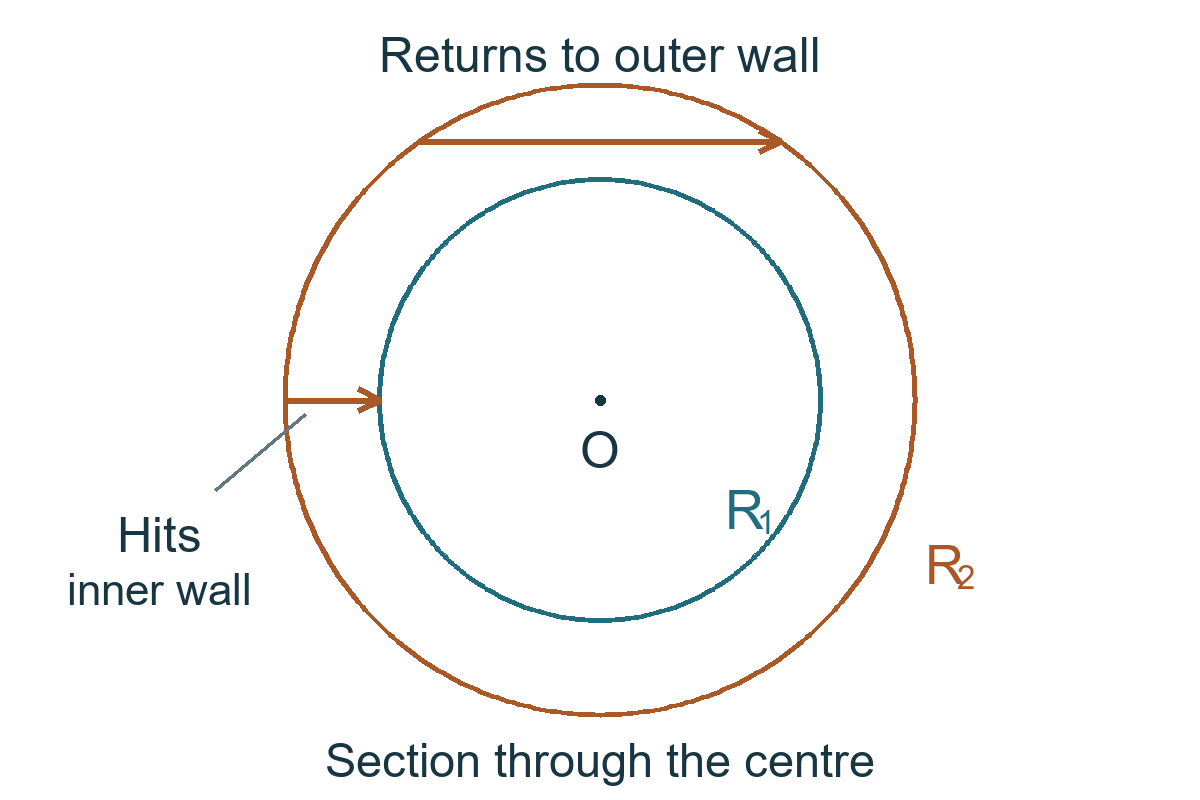
Let \(A_1\) and \(A_2\) be the facing areas. Let \(\kappa\) be the fraction of the diffuse power leaving the outer wall that next reaches the inner wall. It is a power fraction, not a fraction of unweighted directions.
Find the fraction using thermal equilibrium
Imagine replacing the surfaces by black surfaces and keeping both at the same temperature \(T\). This changes their emission and absorption, but leaves the geometrical interception fraction for diffuse radiation unchanged.
The inner sphere emits \(A_1\sigma T^4\), all of which reaches the outer wall. A fraction \(\kappa\) of the outer wall’s emitted power \(A_2\sigma T^4\) reaches the inner sphere. At equilibrium the inner sphere gains no net energy, so
For the given radii,
Thus 49 percent of the diffuse power leaving the outer wall next reaches the inner wall. The remaining 51 percent returns to the outer wall without touching the inner one. All power leaving the inner wall reaches the outer wall.
Diffuse reflection redistributes the radiation over outgoing directions, so these geometrical fractions apply again after reflection.
Count emission and every reflection
Write two steady radiation balances
Let \(J_1\) and \(J_2\) be the total radiant power leaving unit area of the inner and outer facing surfaces. Each includes thermal emission and reflected incident radiation, and has units \(\mathrm{W\,m^{-2}}\). Spherical symmetry makes each quantity uniform over its surface.
The inner sphere receives power \(\kappa A_2J_2=A_1J_2\). Its incident power per unit area is therefore \(J_2\). Adding its own emission to the reflected part gives
The outer wall receives all of \(A_1J_1\), together with its own returning power \((1-\kappa)A_2J_2\). Divide by \(A_2\) to obtain the incident power per unit area. Then
These balances include repeated reflections because each reflected part comes from the total radiation reaching the wall.
Find the net inward heat transfer
Put \(\Delta J=J_2-J_1\). The first balance gives
In the second balance, replace \(\kappa J_1+(1-\kappa)J_2\) by \(J_2-\kappa\Delta J\). Rearranging gives
Substituting this into the expression for \(\Delta J\) gives
The inner wall absorbs \(\varepsilon A_1J_2\) and emits \(\varepsilon A_1\sigma T_1^4\). The difference is \(A_1\Delta J\). Hence
For the given sphere,
The denominator is \(1+0.90(0.49)=1.441\). Substituting the given values in SI units,
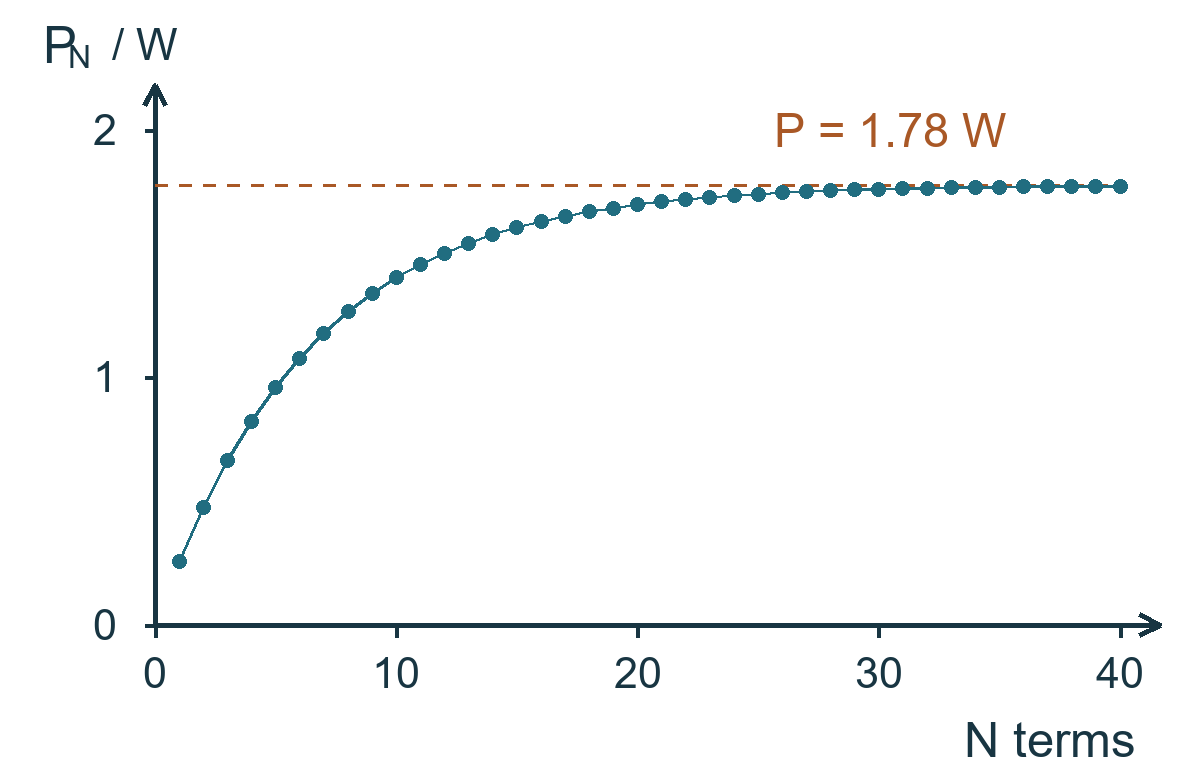
Answer a The net inward heat-transfer rate is about \(1.78\,\mathrm{W}\). The powers \(A_1J_1\) and \(A_2J_2\) include radiation that is reflected again; neither is the net heating rate.
Convert heat input into evaporation time
Use the volume of the inner sphere
Initially the liquid fills the inner vessel, so
This is about \(1.437\,\mathrm{L}\). The vacuum gap contains no liquid. The initial nitrogen mass is
Convert mass into moles
The given latent heat is per mole. First find the amount of nitrogen:
The energy needed to vaporize the whole charge is
Equivalently, the latent heat per kilogram is \(L_m/M=1.99286\times10^5\,\mathrm{J\,kg^{-1}}\). Multiplying this by \(m\) gives the same energy.
Why the power stays constant
Both wall temperatures, the facing areas and the emissivities stay fixed. The shrinking liquid volume therefore does not change \(P\) in this model. The liquid is already boiling, so the heat supplies phase change; no \(mc\Delta T\) term is needed.
Using \(P\tau=E\), the requested symbolic answer is
Using unrounded intermediate values,
Answer b The complete charge evaporates in about \(36.3\,\mathrm{h}\), roughly a day and a half. The official solution rounds this to \(36\,\mathrm{h}\).
| Part | Result |
|---|---|
| a | Net radiative heat input \(P\simeq1.78\,\mathrm{W}\) |
| b | Complete evaporation time \(\tau\simeq36.3\,\mathrm{h}\) |
Check the answer by summing reflections
Follow repeated returns
The outer wall emits \(P_{\mathrm{em},2}=\varepsilon\sigma A_2T_2^4\). The inner wall absorbs a fraction \(\kappa\varepsilon\) on the first flight. The rest reaches the outer wall, which reflects a fraction \(1-\varepsilon\). Each repetition therefore retains the factor
The power originating at the outer wall and eventually absorbed at the inner wall is
The inner wall emits \(P_{\mathrm{em},1}=\varepsilon\sigma A_1T_1^4\). All of it first reaches the outer wall, which absorbs a fraction \(\varepsilon\). Further encounters have the same return factor \(q\), so
Since \(1-q=\varepsilon[1+(1-\varepsilon)\kappa]\), the difference reproduces the earlier result:
Physical checks and points to remember
Equal wall temperatures give \(P=0\). A warmer outer wall gives positive inward heat transfer.
For black surfaces, \(P=\sigma A_1(T_2^4-T_1^4)\). Perfectly reflecting surfaces give zero heat transfer in the limiting model.
As \(R_1/R_2\) approaches one, \(P=\varepsilon\sigma A_1(T_2^4-T_1^4)/(2-\varepsilon)\), the equal-area limit.
Use \(4\pi R_1^2\) for radiation and \(4\pi R_1^3/3\) for liquid capacity. Multiply molar latent heat by the number of moles.
Sources and further reading
The problem is from the VIII Estonian–Finnish Olympiad in Physics, 2010, Problem 2. See the original question and official solution, PDF page 1 in each. The original numerical data are retained. The model assumptions and nitrogen molar mass are stated explicitly, and all three diagrams are independently prepared.
The official final answers agree. We retain \(\kappa\) in the intermediate denominator and explicitly convert mass to moles using \(n=m/M\).