
Interception and Pure Pursuit
Before you begin
You should know Cartesian components, relative velocity, circles, tangents and quadratic equations. The minimum-speed section uses differentiation; the optional pure-pursuit section also uses integration.
Can a slower animal catch a faster one? It can, if it starts in a suitable place and aims at a point the runner will reach later. Continually aiming at the runner’s present position is a different strategy and can fail with the same starting data.
We first construct all starting positions that allow interception during a finite straight run. We then find the earliest meeting, the minimum required speed and, in an optional calculus extension, the closest approach during pure pursuit.
The problem
A ground squirrel runs straight from burrow \(A\) to burrow \(B\), a distance \(d\) apart, at constant speed \(u\). A fox at \(F_{0}\) starts at the same instant, with maximum speed \(v=u/3\). It knows the route and may choose or change direction freely, or wait. Treat both animals as points on an unobstructed horizontal plane; neglect acceleration and turning limits.
Set \(A=\left(0,0\right)\), \(B=\left(d,0\right)\) and \(F_{0}=\left(X,Y\right)\). The squirrel reaches \(B\) at \(t=d/u\). Capture means that their positions coincide at some time \(0\leq t\leq d/u\); arrival together at \(B\) counts as capture. Determine the dangerous starting positions if the squirrel makes the run.
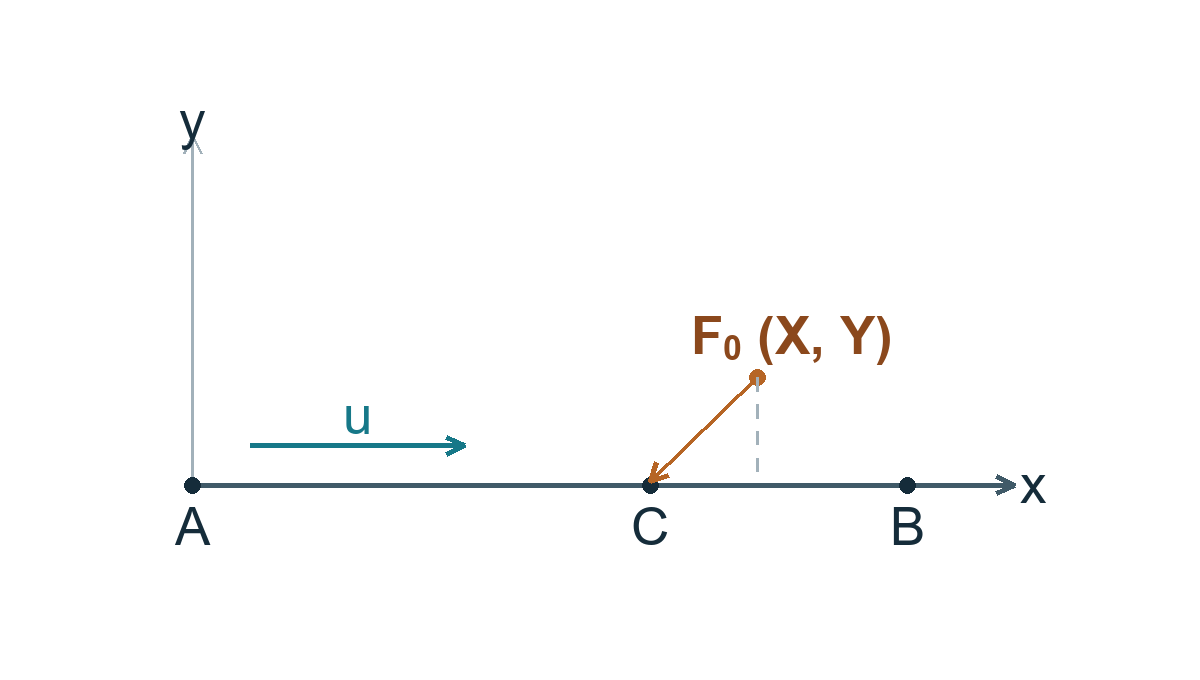
Part a. Construct the complete region of possible fox starting positions that permit capture. Justify every part of its boundary.
Part b. Find the exact area of this region in terms of \(d\).
Turn interception into a region of starting points
For the derivation, write \(k=v/u\) with \(0<k<1\); the original value is \(k=1/3\). Suppose capture occurs at \(C=\left(s,0\right)\), where \(0\leq s\leq d\). The squirrel takes time \(t=s/u\) to reach \(C\). During that time the fox can cover at most \(vt=ks\).
Thus capture at this particular point is possible exactly when
This is a filled disk of radius \(ks\) centred at \(C\). A fox inside it can go to \(C\) and wait. A fox on its circumference reaches \(C\) by running directly there at full speed.
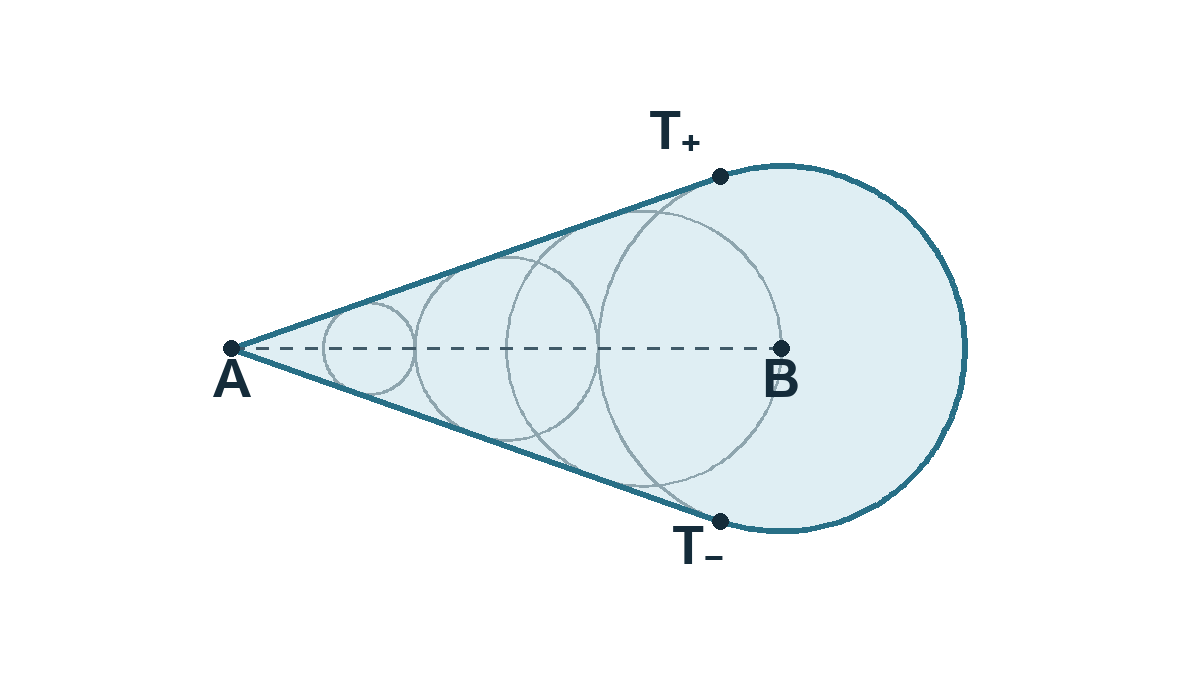
Why the disks must be united
The fox needs one successful meeting point, so a starting position must lie in at least one disk. Intersection would demand success at every time; at \(s=0\) the disk is only the point \(A\).
Locate the straight and curved boundaries
Each disk is a scaled copy of the final disk of centre \(B\) and radius \(kd\), using \(A\) as the scaling centre. Their union fills the region between \(A\) and the final disk, bounded by two tangents from \(A\) and the exposed final arc.
Let \(T_{+}\) and \(T_{-}\) be the tangent points, and let each tangent make angle \(\alpha\) with \(AB\). Since \(BT_{+}\perp AT_{+}\),
Resolving the tangent length along and perpendicular to \(AB\) gives
The boundary lines are \(Y=\pm kX/\sqrt{1-k^{2}}\), from \(A\) to these tangent points. The remaining boundary is the right-hand major arc of \(\left(X-d\right)^{2}+Y^{2}=k^{2}d^{2}\).
Calculate the area with the correct central angle
Split the region into right triangles \(ABT_{+}\) and \(ABT_{-}\) and the major sector facing away from \(A\).
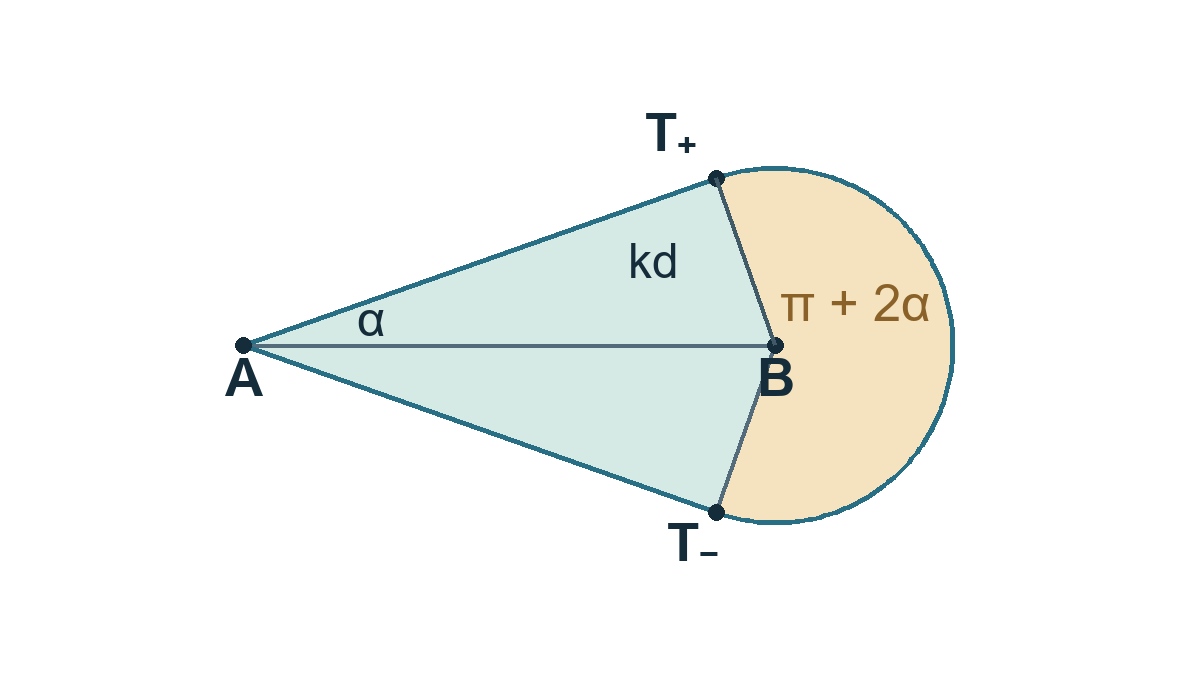
Each right triangle has perpendicular sides \(kd\) and \(d\sqrt{1-k^{2}}\). Their combined area is
In triangle \(ABT_{+}\), the angle at \(B\) is \(\pi/2-\alpha\). The two such angles make the excluded sector \(\pi-2\alpha\). Hence the retained major sector has angle
Its area is \(\frac{1}{2}(kd)^{2}\left(\pi+2\alpha\right)\). Adding gives the general result
For the original speed ratio \(k=1/3\),
Use radians for the angle in this area formula. For checking, \(\alpha={19.4712}^{\circ }\) and the retained sector is \({218.9424}^{\circ }\), larger than a semicircle.
Check the geometry
As \(k\to 0\), the area tends to zero. As \(k\to 1^{-}\), \(\alpha\to \pi/2\) and \(S\to \pi d^{2}\): at equal speeds the final disk, of radius \(d\), contains all the earlier disks. Both limits support the geometry.
Find the earliest interception
Question. For a specified starting point \(F_{0}=\left(X,Y\right)\) and \(0<v<u\), obtain an exact test for capture by the deadline and a formula for the earliest possible interception time.
At time \(t\), the squirrel is at \(\left(ut,0\right)\). The straight-line distance from the fox’s starting point must not exceed \(vt\):
After expansion, the allowed times satisfy
Define
For a starting point other than \(A\), capture is possible if and only if \(X>0\), \(D\geq 0\), and the smaller root below does not exceed \(d/u\):
The reachable times lie between the roots, intersected with the allowed time interval. The first is therefore
At \(t_{-}\) the required distance is exactly \(vt_{-}\), so the fox follows the straight segment to \(\left(ut_{-},0\right)\) at full speed. Any detour has greater length and cannot give an earlier meeting. If \(F_{0}=A\), capture occurs immediately at \(t=0\).
A spatial form of the same test
The following two portions join at the tangent points. Together they describe the full capture region; positions outside the stated \(X\) ranges are excluded.
| Range of initial coordinate \(X\) | Allowed initial coordinate \(Y\) |
|---|---|
| \(0\leq X\leq d(1-k^{2})\) | \(\lvert Y\rvert\leq kX/\sqrt{1-k^{2}}\) |
| \(d(1-k^{2})\leq X\leq d(1+k)\) | \((X-d)^{2}+Y^{2}\leq k^{2}d^{2}\) |
A real root is not enough. For example, a fox at \(\left(2d,0\right)\) would meet the squirrel after \(2d/\left(u+v\right)\). Since \(v<u\), that time exceeds \(d/u\): the squirrel has already reached safety. The deadline removes the far end of the infinite interception wedge and creates the circular cap.
Compare two possible interception headings
Question. Take \(d=120\ \mathrm{m}\), \(u=12\ \mathrm{m\,s^{-1}}\), \(v=4\ \mathrm{m\,s^{-1}}\) and \(F_{0}=\left(90,30\right)\ \mathrm{m}\). Find every interception possible by a single straight run at full speed, including the meeting time, meeting point and velocity vector. Which one is earliest?
The deadline is \(d/u=10\ \mathrm{s}\). A straight run at full speed requires equality in the distance condition:
Both times are positive and less than \(10\ \mathrm{s}\). The required constant velocity is displacement divided by the chosen time:
| Alternative run | Meeting time | Meeting point | Fox velocity |
|---|---|---|---|
| First | \(7.500\,\mathrm{s}\) | \(C_{1}=(90,0)\,\mathrm{m}\) | \(-4\hat{\jmath}\,\mathrm{m\,s^{-1}}\) |
| Second | \(9.375\,\mathrm{s}\) | \(C_{2}=(112.5,0)\,\mathrm{m}\) | \((2.4\hat{\imath}-3.2\hat{\jmath})\,\mathrm{m\,s^{-1}}\) |
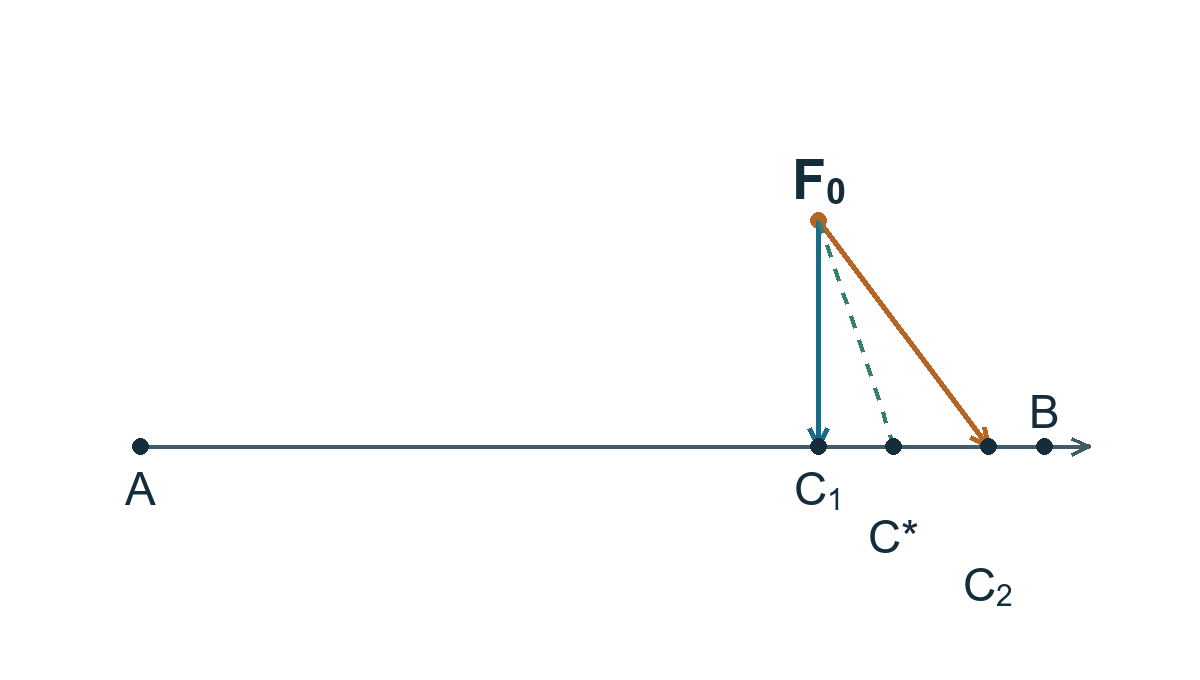
Earliest capture: \(7.500\ \mathrm{s}\), running vertically downward to a point ahead of the squirrel.
Check using relative velocity
For the first run, the squirrel’s position relative to the fox is initially \(-90\widehat{\imath }-30\widehat{\jmath }\) metres. Its relative velocity is \(12\widehat{\imath }+4\widehat{\jmath }\) metres per second. Thus
Both components become zero at \(t=7.5\ \mathrm{s}\). The second run has speed \(\sqrt{{2.4}^{2}+{3.2}^{2}}=4\ \mathrm{m\,s^{-1}}\) and covers \(37.5\ \mathrm{m}\) in \(9.375\ \mathrm{s}\), providing an independent distance check.
Find the minimum speed that succeeds
Question. Keep the same prescribed squirrel motion and the same starting point. What is the smallest speed capability that would allow the fox to intercept before or at \(B\)? Derive a general rule for a nonzero starting point \(\left(X,Y\right)\), then evaluate the numerical example.
If the meeting point is \(\left(s,0\right)\) with \(0<s\leq d\), the squirrel arrives in time \(s/u\). A direct run requires speed
Minimise its square, which is smallest at the same meeting point:
When \(X>0\) and \(X^{2}+Y^{2}\leq dX\), this derivative changes from negative to positive at
The condition \(X^{2}+Y^{2}\leq dX\) describes the disk with diameter \(AB\). It tells us when the best meeting point lies on the available segment. If \(X\leq 0\), or if \(X>0\) but \(X^{2}+Y^{2}>dX\), the required speed decreases throughout the available interval. The best meeting point is then \(B\):
This minimum-speed calculation does not assume in advance that \(v_{\mathrm{min}}<u\). A result at least as large as \(u\) means that a slower fox cannot succeed from that position. If the fox starts at \(A\), the minimum is zero because capture is immediate. A stationary fox already on the segment can also intercept when the squirrel reaches it.
Apply the rule to the numerical example
Here \(X^{2}+Y^{2}=9000\,\mathrm{m}^{2}\) is less than \(dX=10800\,\mathrm{m}^{2}\), so the interior optimum applies:
The corresponding velocity is \(1.2\widehat{\imath }-3.6\widehat{\jmath }\) metres per second. Its magnitude is \(12/\sqrt{10}\), and after \(25/3\) seconds both animals are at \(C_{*}=\left(100,0\right)\ \mathrm{m}\).
Minimum speed and minimum time are different objectives. With a \(4\ \mathrm{m\,s^{-1}}\) capability, the earliest meeting is at \(7.5\ \mathrm{s}\). Using only the minimum required speed gives a later meeting at \(8.333\ldots \ \mathrm{s}\).
Optional extension Pure pursuit
This section uses differentiation, integration and a differential equation for the line of sight. It is a mathematical extension of the interception problem.
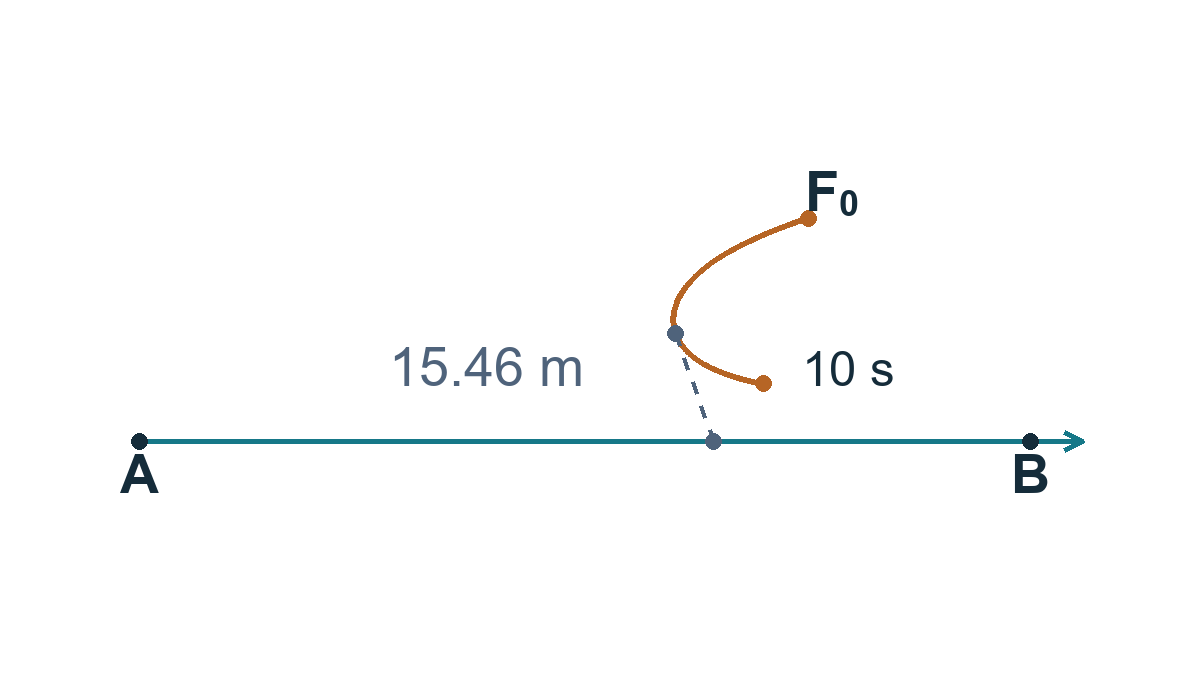
Question. Return to \(u=12\ \mathrm{m\,s^{-1}}\), \(v=4\ \mathrm{m\,s^{-1}}\) and \(F_{0}=\left(90,30\right)\ \mathrm{m}\). Now impose pure pursuit: the fox always runs at full speed directly toward the squirrel’s current position. Can it capture the squirrel before or on reaching \(B\)? Find the least separation during the run and when it occurs.
For the calculation, continue the squirrel’s straight motion mathematically beyond \(B\). We will then check whether the closest approach occurs before the actual deadline of \(10\,\mathrm{s}\). Let the fox’s coordinates be \(\left(x_{F},y\right)\), with \(y>0\), and define
Here \(\theta\) is the clockwise angle, between \(0\) and \(\pi\), from the positive \(x\) direction to the fox-to-squirrel line. The actual relative vector is \(p\widehat{\imath }-y\widehat{\jmath }\). Pure pursuit therefore gives
Differentiating \(r^{2}=p^{2}+y^{2}\) yields the closing-rate equation. Then differentiating \(p=r\cos \theta\) and substituting the component velocities yields the turning-rate equation:
The angle decreases continuously. Dividing these equations eliminates time:
Use the differentiation identities
Integration gives
Initially, \(p_{0}=-90\ \mathrm{m}\), \(y_{0}=30\ \mathrm{m}\) and \(r_{0}=30\sqrt{10}\ \mathrm{m}\). The half-angle identity gives
Why this chase fails: the expression for \(r\) is positive for every \(0<\theta\leq \theta_{0}\). As \(\theta\to 0\), it behaves as \(C2^{-k}\theta^{k-1}\), which grows without bound because \(k<1\). The fox gets closer initially, then falls behind; its separation never reaches zero. This conclusion concerns the specified off-axis start, not a collinear head-on encounter.
Closest approach
The separation stops decreasing when \(\dot{r}=0\), so
As \(\theta\) decreases through this value, \(\dot{r}\) changes from negative to positive. The distance law gives
For the time, combine the two rates:
At closest approach \(p_{m}=kr_{\mathrm{min}}\), so
This is less than \(10\ \mathrm{s}\), so it is the least separation during the actual run to \(B\).
| Quantity | Checked result |
|---|---|
| Original capture-region area | \(0.5265622623\ldots\,d^{2}\) |
| Earliest numerical interception | \(7.500\,\mathrm{s}\) at \((90,0)\,\mathrm{m}\) |
| Other straight full-speed interception | \(9.375\,\mathrm{s}\) at \((112.5,0)\,\mathrm{m}\) |
| Minimum required speed | \(12/\sqrt{10}\,\mathrm{m\,s^{-1}}\) at \((100,0)\,\mathrm{m}\) |
| Pure-pursuit outcome | No capture; least gap \(15.4625\,\mathrm{m}\) at \(6.43927\,\mathrm{s}\) |
Teaching point: choosing an interception point and continually aiming at the target impose different velocity directions. The same starting data can therefore produce capture or escape.
Sources and further reading
The initial region-and-area problem and speed ratio are based on Rosatom Physics Olympiad 2023–24, final round, Grade 9, Problem 5. The explanation and all diagrams here are independently prepared; the later challenges are extensions in the supplied teaching document. Original question and official solution (question on PDF page 1; solution on PDF pages 6–7).
The official solution’s diagram gives the intended region, but the required set is the union of the disks. The excluded sector at B has angle \(\pi-2\alpha\), so the retained sector has angle \(\pi+2\alpha\). The area derived in this article uses that corrected angle.
Relative velocity and Cartesian kinematics are standard senior-secondary tools. The pure-pursuit differential equation is treated here as an optional extension, not as a claim that this particular pursuit problem is prescribed in the JEE syllabus. Official JEE Advanced 2026 syllabus.