
Hot Air Balloon
Before you begin
You should know buoyancy, the ideal-gas law, conduction through a slab and the Stefan–Boltzmann law. The final approximation check also uses a first-order expansion.
How much payload can a hot-air balloon support, and how much heating keeps it aloft? We will first use the force balance to find the air temperature, then use conduction, convection and radiation to find the heat loss.
The problem
A spherical hot-air balloon has an impermeable nylon envelope. The basket, burner and supporting frame have total mass \(m_{k}\); the fabric mass is additional. The balloon contains only air, without burner exhaust. Use the following data.
| Quantity | Value |
|---|---|
| Radius \(r\) | \(9.0\,\mathrm{m}\) |
| Equipment mass \(m_k\) | \(200\,\mathrm{kg}\) |
| Fabric thickness \(d\) | \(0.10\,\mathrm{mm}\) |
| Fabric density \(\rho_t\) | \(1100\,\mathrm{kg\,m^{-3}}\) |
| Conductivity \(\lambda\) | \(0.30\,\mathrm{W\,m^{-1}\,K^{-1}}\) |
| Inner fabric limit \(T_1\) | \(100\,{}^\circ\mathrm{C}\) |
| Ambient temperature \(T_0\) | \(25\,{}^\circ\mathrm{C}\) |
| Air pressure \(p_0\) | \(1.00\times10^5\,\mathrm{Pa}\) |
| Convection coefficient \(\alpha\) | \(3.0\,\mathrm{W\,m^{-2}\,K^{-1}}\) |
| Thermal reflectivity \(a\) | \(0.70\) |
Treat the envelope as a thin sphere of fixed radius. The internal air has uniform temperature \(T_{v}\) and is at the same temperature as the inner fabric surface; let \(T_{s}\) be the outer surface temperature. Both air pressures equal \(p_{0}\). Pressure equalisation is allowed through a small opening, whose heat loss is neglected; the fabric itself does not leak.
The outward convective heat flux is \(j_{\mathrm{conv}}=\alpha\left( T_{s}-T_{0} \right)\). Treat the envelope as an opaque grey surface with thermal-infrared reflectivity \(a\). The radiative surroundings are at \(T_{0}\); ignore sunlight and all other heat losses. The fabric temperature drop \(\Delta T=T_{v}-T_{s}\) is small compared with \(T_{v}-T_{0}\).
Part a. Find the greatest payload mass that permits hovering without exceeding the fabric temperature limit.
Part b. At this greatest payload, estimate the temperature drop between the inner and outer fabric surfaces.
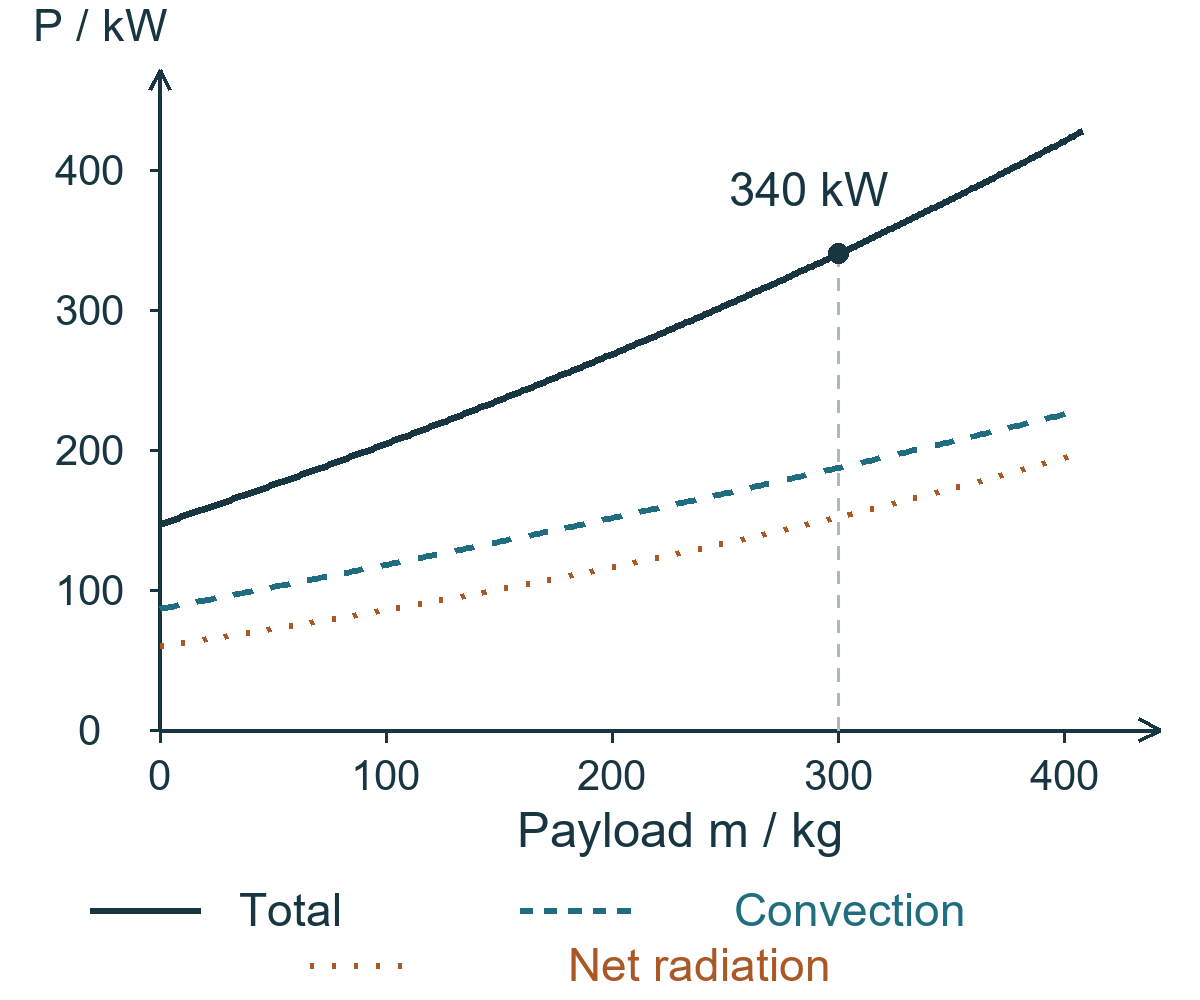
Part c. With a payload of \(300\ \mathrm{kg}\), find the internal-air temperature required for hovering and the steady burner power delivered to that air.
Constants and numerical convention. Use ideal-gas air with \(M=0.029\ \mathrm{kg}\,\mathrm{mol}^{-1}\), \(R=8.30\ \mathrm{J}\,\mathrm{mol}^{-1}\,\mathrm{K}^{-1}\) and \(\sigma=5.67\times 10^{-8}\ \mathrm{W}\,\mathrm{m}^{-2}\,\mathrm{K}^{-4}\). Use the source’s rounded absolute temperatures \(T_{0}=298\ \mathrm{K}\) and \(T_{1}=373\ \mathrm{K}\). Neglect envelope thickness when calculating the balloon volume and surface area. A numerical value of \(g\) is unnecessary.
Part a Maximum payload
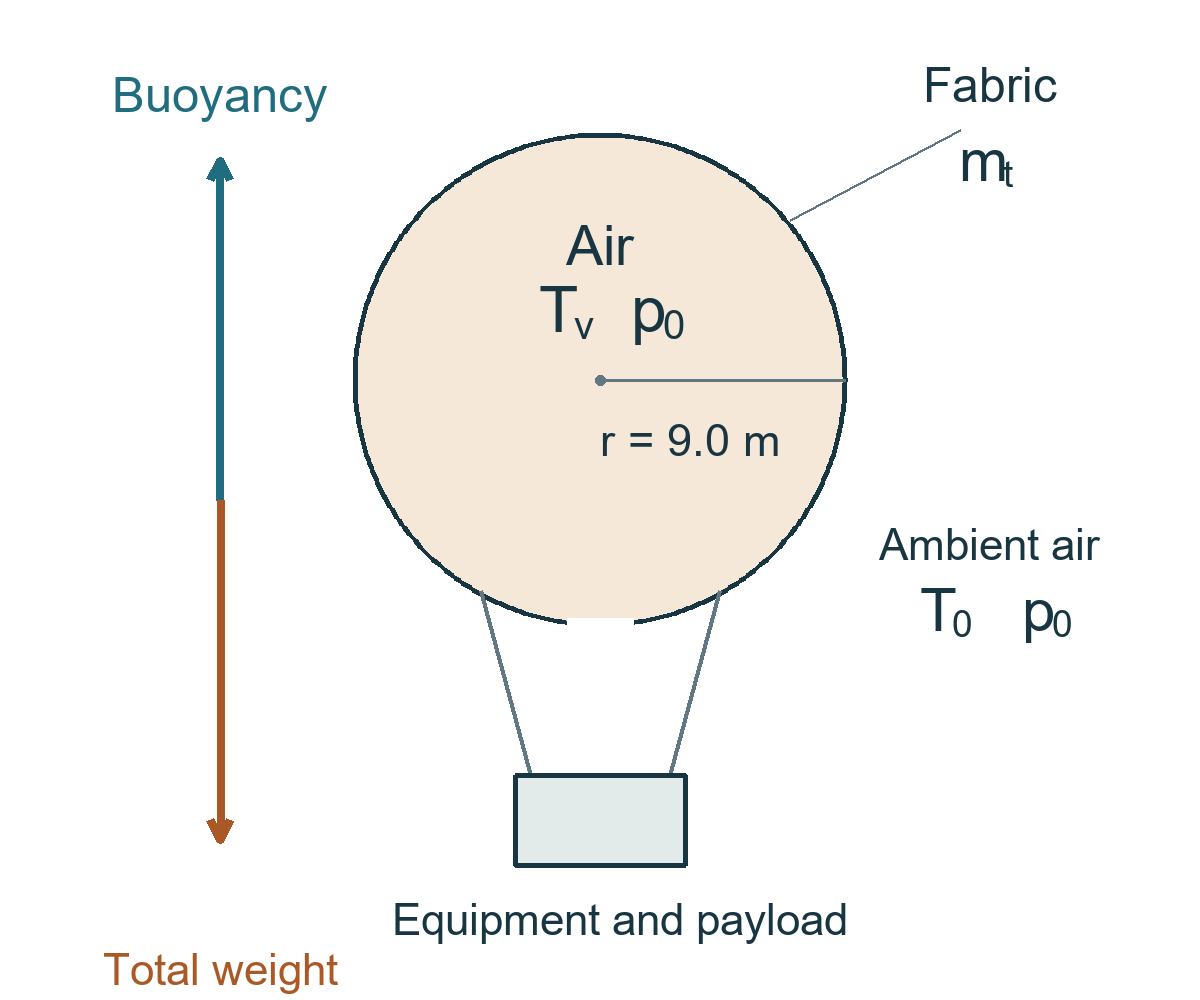
Count the fabric and the enclosed air
The envelope area and enclosed volume are
The fabric volume is approximately \(Sd\), so its mass is
From \(pV=nRT\) and \(n=m_{\mathrm{air}}/M\), the air density is \(\rho(T)=p_{0}M/(RT)\). Thus the displaced ambient-air mass is \(\rho\left( T_{0} \right)V\), while the enclosed hot-air mass is \(\rho\left( T_{v} \right)V\).
For hovering, buoyancy balances all the downward weights:
Cancelling \(g\) and solving for the payload gives
Apply the temperature limit
At fixed volume and ambient conditions, the buoyant force is constant. Raising \(T_{v}\) reduces the enclosed-air density and weight, so more payload can be supported. The maximum allowed inner temperature is \(T_{v}=T_{1}=373\ \mathrm{K}\).
Mass check. The displaced ambient air has mass \(3580.30\ \mathrm{kg}\); the hot air at \(373\ \mathrm{K}\) has mass \(2860.40\ \mathrm{kg}\). Their difference, \(719.90\ \mathrm{kg}\), must support the \(200\ \mathrm{kg}\) equipment, \(111.97\ \mathrm{kg}\) fabric and approximately \(408\ \mathrm{kg}\) payload.
Part b Temperature drop across the fabric
Add the two exterior heat losses
For an opaque grey surface, absorptivity is \(1-a\). Kirchhoff’s law makes the emissivity equal to this absorptivity, so \(\varepsilon=0.30\). The net radiation loss includes radiation received from the surroundings:
The total outward heat flux is
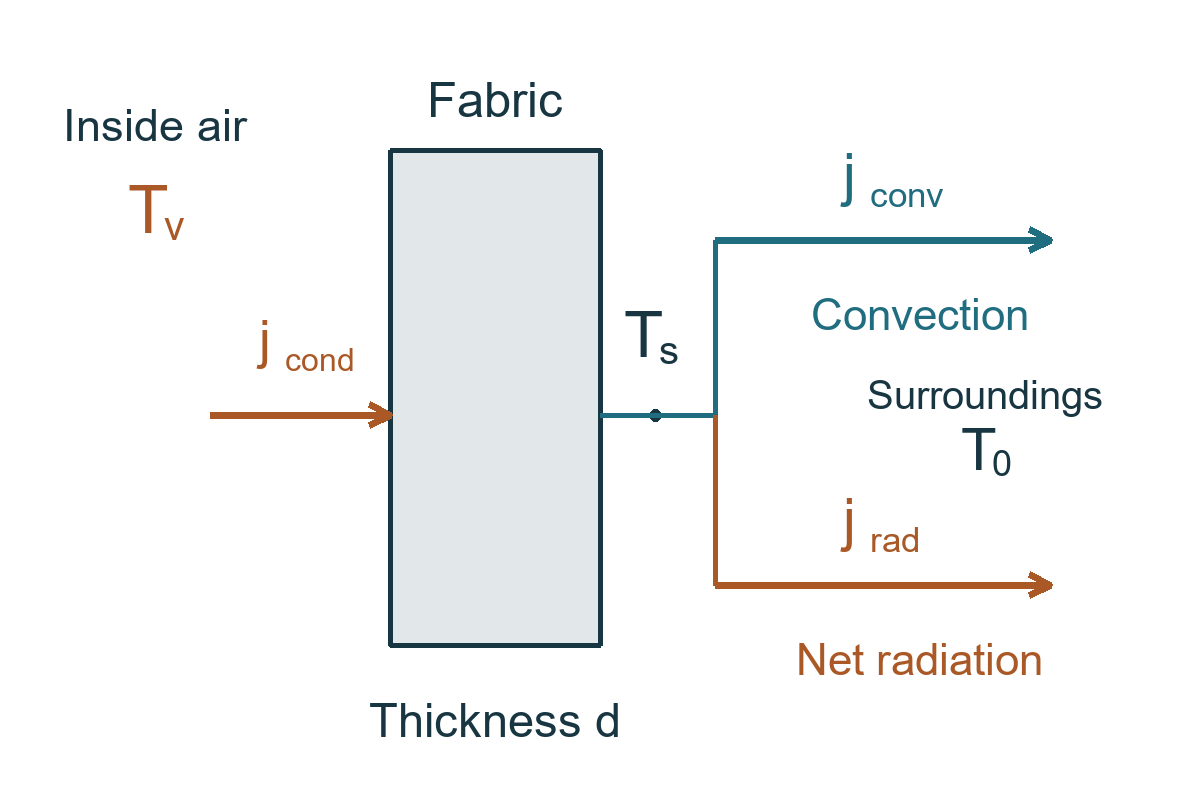
Conduction through the wall is in series with the exterior loss processes. Convection and radiation act together at the outer surface. In steady state,
Use and then check the small temperature drop
At maximum payload, \(T_{v}=373\ \mathrm{K}\). First evaluate the exterior loss with \(T_{s}\simeq T_{v}\):
The convection contribution is \(225.00\ \mathrm{W}\,\mathrm{m}^{-2}\) and the net radiation contribution is \(195.12\ \mathrm{W}\,\mathrm{m}^{-2}\). Therefore,
Answer: the outer fabric face is only about \(0.14\ \mathrm{K}\) cooler than the inner face. The ratio \(\Delta T/\left( T_{v}-T_{0} \right)\simeq 0.00187\) confirms the supplied small-drop approximation. A small temperature drop does not imply a small heat flux: the wall conductance per unit area is \(\lambda/d=3000\ \mathrm{W}\,\mathrm{m}^{-2}\,\mathrm{K}^{-1}\).
Part c Temperature and burner power
Obtain the temperature from the hovering condition
Put \(m=300\ \mathrm{kg}\) in the force balance before calculating heat loss. Rearrangement gives
This is approximately \(86\ {}^\circ\mathrm{C}\) and is below the fabric limit. The contained-air mass is \(2968.34\ \mathrm{kg}\); together with the fabric, equipment and payload, it equals the displaced-air mass.
Match the burner input to the total loss
For a steady temperature, the burner must replace the heat leaving the envelope. Using the original problem’s approximation \(T_{s}\simeq T_{v}\),
| Contribution | Heat flux | Power over the envelope |
|---|---|---|
| Convection | \(184.31\,\mathrm{W\,m^{-2}}\) | \(187.61\,\mathrm{kW}\) |
| Net radiation | \(149.78\,\mathrm{W\,m^{-2}}\) | \(152.45\,\mathrm{kW}\) |
| Total | \(334.09\,\mathrm{W\,m^{-2}}\) | \(340.06\,\mathrm{kW}\) |
Answer: the required heat delivered to the internal air is approximately \(340\ \mathrm{kW}\). This is a power, not a stored quantity of heat. Fuel consumption would additionally require the fuel’s energy content and the burner efficiency.
Check the thin fabric approximation
This section extends the original solution. Keep the distinction between \(T_{v}\) and \(T_{s}\) while retaining the same idealised balloon model.
Retain the finite wall temperature drop
For a given payload, the force balance fixes \(T_{v}\). The unknown outer temperature satisfies
There is one solution between \(T_{0}\) and \(T_{v}\): the conduction side decreases as \(T_{s}\) rises, while the exterior-loss side increases. Once \(T_{s}\) is found, the burner power is \(P=Sj\left( T_{s} \right)\).
| Quantity | Original approximation | Finite wall calculation |
|---|---|---|
| Fabric drop at maximum payload | \(0.14004\,\mathrm{K}\) | \(0.13973\,\mathrm{K}\) |
| Outer temperature for \(300\,\mathrm{kg}\) | \(359.437\,\mathrm{K}\) | \(359.326\,\mathrm{K}\) |
| Burner power for \(300\,\mathrm{kg}\) | \(340.060\,\mathrm{kW}\) | \(339.363\,\mathrm{kW}\) |
The approximation overestimates the 300 kg heat requirement by about 0.21%. Both approaches give approximately \(340\ \mathrm{kW}\) at the intended precision. The additional digits in this comparison quantify the approximation; they do not represent equally precise physical data.
An accurate correction without solving a quartic
Let \(K=\lambda/d\) and \(\delta=T_{v}-T_{s}\). Expand the exterior flux to first order:
Combining this with \(K\delta=j\left( T_{v}-\delta \right)\) gives
For the 300 kg state, \(K=3000\ \mathrm{W}\,\mathrm{m}^{-2}\,\mathrm{K}^{-1}\) and \(j'\left( T_{v} \right)=6.160\ \mathrm{W}\,\mathrm{m}^{-2}\,\mathrm{K}^{-1}\). The ratio is \(j'(T_v)/K\simeq0.00205\). The corrected drop is \(0.1111344\ \mathrm{K}\), agreeing closely with the numerical value \(0.1111345\ \mathrm{K}\).
Points to remember
Use \(4\pi r^{2}\) for the envelope area, not its projected disc area. Include both the fabric and enclosed hot air in the weight. Use absolute temperatures in the gas and radiation laws, and subtract the incoming ambient radiation.
The \(100\ {}^\circ\mathrm{C}\) limit applies to the hotter inner fabric face. The small wall drop does not permit an internal temperature above that limit. The calculated power is the heat supplied to the air within the stated model; it does not include omitted opening losses or startup heating.
Sources and further reading
The problem is from the 60th Slovenian National Physics Competition, 2022, Group III, Question 2. See the DMFA question paper and official solutions: question on PDF page 6 and solution on pages 19 to 20.
All three original tasks and their numerical data are retained in fresh English wording. The idealised assumptions are stated explicitly. The finite-wall comparison and first-order correction extend the original solution, and the three scientific figures are independently prepared.